
The Two-Headed Dragon and the Mountain: A Dream of Inner Conflict and Courage
Part 1: Dream Presentation
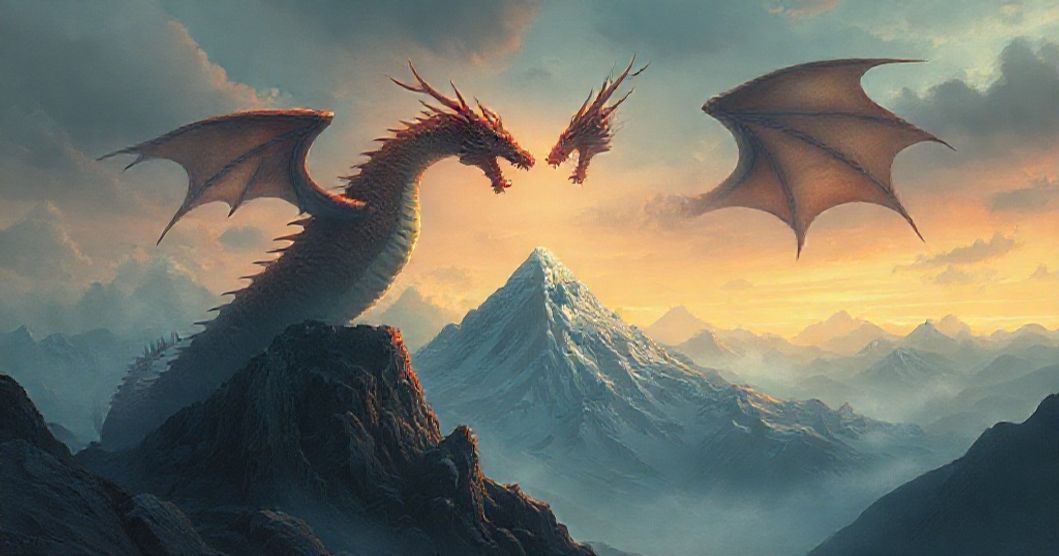
Dreams often serve as portals into the unconscious, revealing truths we may not yet name in waking life. This particular dream arrives like a primal battle cry, echoing with the tension of facing dualities and emerging with a fierce determination to confront what lies ahead. Three weeks ago, I found myself standing atop a mountain that seemed to pierce the very clouds themselves. The air was crisp, carrying the faint scent of pine and something primal, as if the mountain itself held ancient secrets. I felt a strange stillness settle over me, yet beneath it, a tension hummed like electricity—an anticipation of something momentous. Suddenly, from the darkening sky, a creature emerged: a two-headed demon dragon, its scales glistening with obsidian sheen, eyes blazing with infernal fire. One head was serpentine, coiled with malevolence, while the other bore the features of a beast more human in its cruelty. As it swooped toward me, I didn’t feel fear but a strange clarity—a recognition that this was a test, a confrontation I’d been preparing for without knowing it. In that instant, I found myself chanting—a war prayer, instinctual and primal, words I couldn’t fully recall but felt deeply in my bones. Then, with the precision of a warrior in myth, I leaped from the mountain’s edge, just as I’d seen in that God of War scene I’d watched countless times. The world blurred as I plummeted, the dragon’s wings beating against the wind, and I felt alive in a way I rarely do when awake—no fear, only focused determination. We crashed through the clouds, descending into a swirling abyss of shadow and light. The dragon roared, a sound that shook my very core, and I met its gaze with my own. My sword, forged in the heat of my will, materialized in my hand—a blade of pure intention. With a single, powerful swing, I struck one of its heads, severing it cleanly from the creature’s neck. The severed head writhed momentarily, then dissolved into mist. But the other head—still fierce, still unyielding—lunged forward. Its jaws clamped onto my torso, and with a single, merciless heave, it threw me into the depths below. I tumbled, wind whipping past me, and for a moment, I thought this might be the end. Yet as I fell, I felt something shift within me—a resolve that refused to be broken. I recovered mid-fall, positioning my blade for a final strike. The dragon, now headless yet still thrashing, loomed above me. I raised my sword, ready to deliver the killing blow, when the dream faded, leaving only the echo of that moment of intense, focused action.
Part 2: Clinical Analysis
### Symbolic Landscape: Decoding the Dragon and Mountain
Want a More Personalized Interpretation?
Get your own AI-powered dream analysis tailored specifically to your dream
🔮Try Dream Analysis FreeThe mountain itself serves as a powerful symbol of psychological thresholds and spiritual elevation. Standing atop such a peak represents a moment of clarity, a vantage point from which to survey one’s life and confront challenges. In dreamwork, mountains often signify obstacles to overcome, or the highest point of self-realization. The act of leaping from this mountain is equally significant—it embodies a willingness to surrender control and embrace uncertainty, a common theme in dreams of transformation.
The two-headed dragon emerges as the most complex symbol, embodying dualistic forces within the dreamer’s psyche. In myth and psychology, multi-headed creatures typically represent fragmented aspects of self or conflicting internal narratives. The serpentine head may symbolize primal, instinctual drives or unconscious patterns, while the more humanoid head could reflect socialized aggression or external projections. Together, they create a creature that is both beast and human, a hybrid of the wild and the civilized—an archetypal representation of the shadow self, that which we fear or reject within ourselves.
The sword, materializing in the dreamer’s hand, functions as a phallic symbol of power and protection, yet its role is not merely destructive. In the context of a battle, the sword becomes a tool of discernment, allowing the dreamer to distinguish between what is truly threatening and what can be integrated. The act of severing one head while being attacked by the other suggests a process of differentiation—separating what is harmful from what requires attention, yet leaving a residual challenge to address.
The abyss into which the dreamer falls represents the unconscious mind, a realm of emotions and repressed thoughts. Falling often symbolizes letting go of control and trusting the process, even when the outcome seems uncertain. The dragon’s continued attack from above, despite losing one head, suggests that unresolved conflicts persist even after initial attempts at resolution, requiring deeper engagement with these internal struggles.
### Psychological Currents: Jungian and Freudian Perspectives
From a Jungian perspective, this dream reflects the process of shadow integration—the conscious confrontation of repressed or disowned aspects of self. The two-headed dragon embodies the shadow, with its dual nature representing the integration of opposing forces: perhaps the masculine and feminine, the rational and intuitive, or the light and dark aspects of personality. Jung’s concept of the shadow emphasizes that these conflicting parts must be acknowledged and integrated rather than suppressed, and the dream’s action sequence mirrors this process of active confrontation.
Freudian theory, meanwhile, might interpret the dragon as a manifestation of repressed aggression or pent-up anger. The sword becomes a symbolic phallic object, representing the dreamer’s attempt to assert control over repressed impulses. The act of leaping off the mountain could signify a regression to childhood’s sense of omnipotence, a temporary return to a state where the dreamer believes they can conquer any obstacle—a common defense mechanism against anxiety.
Modern psychological frameworks add another layer: the dream may reflect the brain’s natural stress response, where intense challenges trigger the fight-or-flight system even in sleep. The dragon’s appearance could correspond to a waking stressor—a work conflict, relationship tension, or identity crisis—manifesting as a symbolic threat. The