
Part 1: Dream Presentation
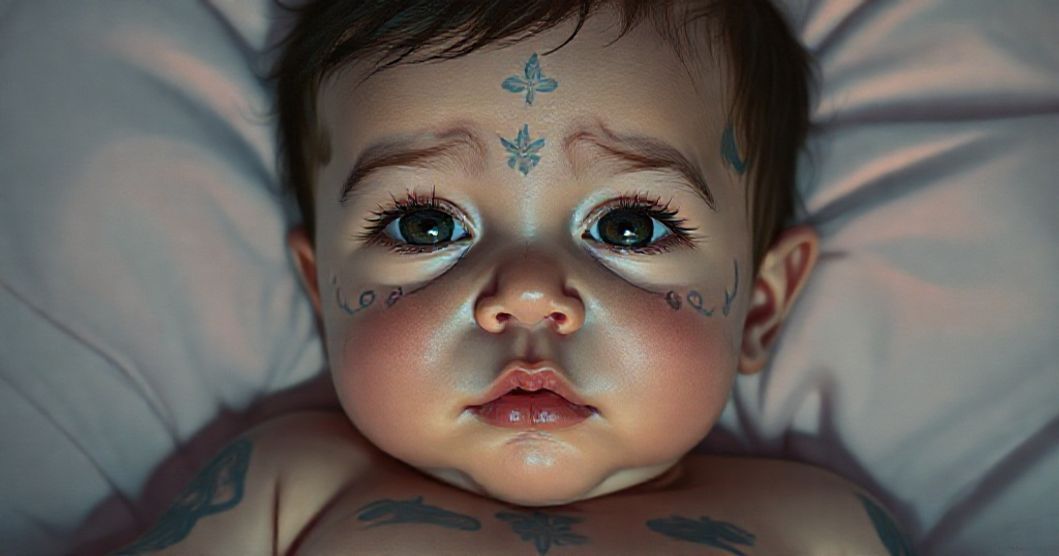
Dreams often bridge past and present, childhood and adulthood, in ways that defy logical explanation. This particular dream weaves together familiar landscapes, unexpected birth imagery, and striking symbolic tattoos to create a narrative that invites exploration of identity, self-expression, and the uncanny. The dream unfolds in a recurring strip mall-like environment—neither a precise memory nor a complete fabrication—that evokes comfort and nostalgia while maintaining an air of strangeness. Despite no signs of pregnancy, the dream delivers an instantaneous, painless birth, yielding a 'Hollywood newborn': a baby that appears months old yet acts with the fragility of an infant, as if staged for cinematic perfection. The baby’s face mirrors the dreamer’s own childhood self, rendered adorable yet unsettling by the presence of two face tattoos—an element absent in the dreamer’s waking life. The attempt to recreate this vision through Google image editing and the lost gibberish above the eyebrow add layers of confusion and curiosity, suggesting an unconscious dialogue about identity, permanence, and the performance of self.
Part 2: Clinical Analysis
Symbolic Landscape: The Tattoos, Newborn, and Familiar Setting
Want a More Personalized Interpretation?
Get your own AI-powered dream analysis tailored specifically to your dream
🔮Try Dream Analysis FreeThe recurring strip mall represents a transitional space—a place of comfort, routine, and childhood memories that have become symbolic of the dreamer’s past. In dreamwork, such reoccurring locations often signify unresolved emotions or themes from childhood that continue to influence the present. The 'Hollywood newborn' introduces a paradox: the baby’s appearance suggests a constructed identity, while its infantile behavior evokes vulnerability and innocence. This contradiction hints at the dreamer’s struggle between authenticity and performance—perhaps feeling pressured to 'perform' a certain version of self in waking life.
The face tattoos, absent in reality, are particularly significant. Tattoos in dreams typically symbolize permanence, self-expression, or societal identity markers. On a newborn, they take on added layers of meaning: the contrast between the baby’s innocence and the tattoos’ permanence suggests a tension between the dreamer’s desire to leave lasting marks on the world and fears of losing their core self. The tattoos’ placement near the temples, a region associated with memory and intuition, reinforces their role as symbolic of deeply held identity markers or repressed aspects of self.
Psychological Perspectives: Jungian, Freudian, and Cognitive Frameworks
From a Jungian perspective, the baby represents the dreamer’s 'shadow' or 'anima/animus'—the unconscious aspects of self that remain unintegrated. The tattoos could symbolize the shadow’s attempt to assert itself, even in the most vulnerable state. The 'Hollywood newborn' might reflect the dreamer’s projection of societal ideals onto their own self, particularly regarding perfection and performance. In Freudian terms, the painless birth could represent a desire for new beginnings without the anxiety of real-world challenges, while the tattoos might symbolize repressed desires or forbidden self-expression that the dreamer fears acknowledging.
Cognitively, dreams function as problem-solving mechanisms, and this dream’s elements might reflect the dreamer’s current efforts to reconcile their authentic self with external expectations. The 'Hollywood' aspect suggests a commentary on how society commodifies and performs identity—turning childhood innocence into a staged performance. The gibberish above the eyebrow could represent the dreamer’s inability to articulate these complex feelings in waking life, manifesting as nonsensical symbols in sleep.
Emotional and Life Context: Unpacking Inner Turmoil
The dream’s focus on a baby resembling the dreamer as a child suggests a reconnection with childhood self. This might indicate the dreamer is processing unresolved aspects of their past, perhaps questioning how childhood experiences shape their current identity. The 'Hollywood newborn' could reflect societal pressures to conform to certain ideals of success or appearance, while the tattoos represent the dreamer’s own attempt to 'brand' or permanently mark their identity—a conflict between wanting to be authentic and wanting to meet external expectations.
The painless birth contrasts with the permanence of tattoos, creating an emotional tension: the dreamer might feel both a desire for effortless self-expression and a fear of permanent commitment to societal roles. The reoccurring strip mall reinforces this theme, as a space where the dreamer once felt safe and familiar, now transformed into a symbolic threshold between past and present.
Therapeutic Insights: Integrating the Dreamer’s Inner Self
This dream offers several therapeutic avenues for exploration. First, the dreamer should reflect on how they currently express their identity—are they 'performing' a version of self for others, or embracing their authentic self? Journaling about childhood memories and current life goals could help identify where this tension arises.
The tattoos, absent in waking life, might represent a desire to leave a lasting mark on the world without compromising one’s core identity. The dreamer could explore what aspects of themselves they feel pressured to 'permanently' express versus those they fear losing. The 'Hollywood newborn' suggests a need to balance performance with authenticity—perhaps letting go of societal expectations of 'perfection' and embracing the messy, unscripted aspects of self.
Practical exercises include creating a timeline of childhood and current self, identifying moments where the dreamer felt pressured to conform, and journaling about the emotions triggered by the tattoos. Reflecting on whether the dreamer feels 'staged' in certain life areas could reveal where they might need to reclaim authenticity.
FAQ Section
Q: Why would a dreamer see a baby that looks like themselves?
A: This often represents the dreamer’s inner child, core self, or unintegrated aspects of identity—parts of themselves they may have neglected or tried to suppress.
Q: What do face tattoos symbolize in a dream about a baby?
A: Tattoos symbolize permanence and self-expression. On a baby, they suggest tensions between wanting to leave lasting marks and fears of losing innocence or authenticity.
Q: How does the 'Hollywood newborn' element contribute to the dream’s meaning?
A: It comments on societal pressures to perform identity, conform to ideals of perfection, and balance authenticity with external expectations, suggesting the dreamer may feel 'staged' in certain life areas.