
Part 1: Dream Presentation
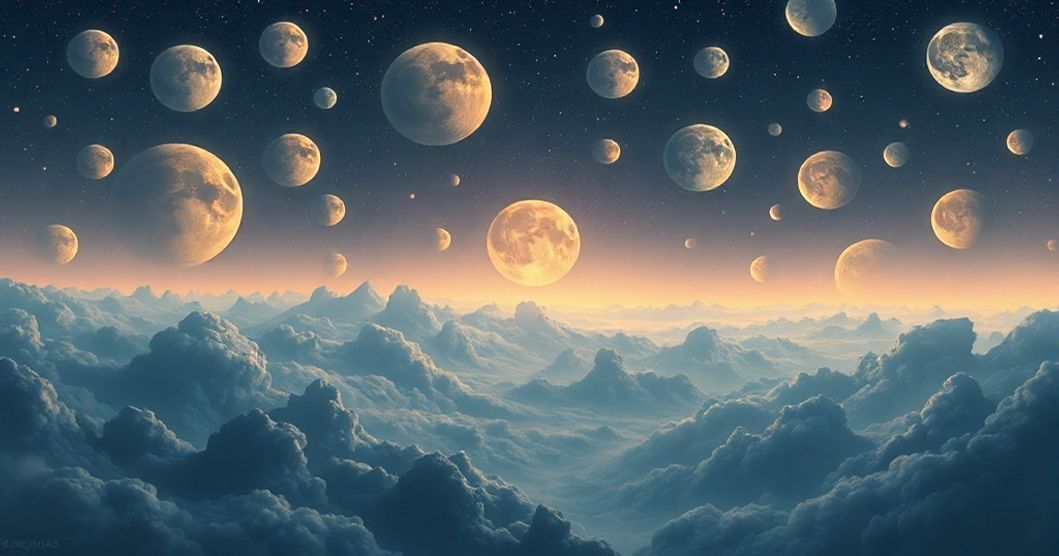
Dreams often serve as windows into our subconscious, offering fragmented yet profound insights into our emotional, psychological, and spiritual landscapes. In this particular dream, the dreamer finds themselves on a cliffside, a liminal space between the known and unknown, as the night sky reveals an impossible celestial phenomenon: dozens of moons, each in varying phases and most in eclipse. The dream unfolds with a dialogue between the dreamer and a friend, highlighting the subjective nature of perception and the shared yet individual experience of reality.
I stood on the edge of a weathered cliff, the cool night air nipping at my skin as I tilted my head upward. What I saw there defied all reason—a sky not merely dark but ablaze with moons, dozens of them, scattered like luminous jewels across the velvet expanse. My breath caught in my chest; I’d never imagined such a sight, yet it felt both familiar and profoundly alien. Most of these moons were veiled in eclipse, their edges blurred by shadow, while others glowed in perfect crescents, half-moons, or full phases, each one a different chapter of lunar existence. I turned to the friend beside me, my voice trembling slightly with disbelief, and asked, ‘Do you see them?’
He followed my gaze, his brow furrowed in confusion. ‘See what?’ he replied, his tone betraying the same bewilderment I felt. ‘All of them,’ I said, gesturing upward. ‘The moons—dozens of them. Everywhere.’
Want a More Personalized Interpretation?
Get your own AI-powered dream analysis tailored specifically to your dream
🔮Try Dream Analysis FreeThe cliff beneath my feet felt solid yet unstable, as if the ground itself were a metaphor for the dream’s surreal logic. The friend’s question echoed in my mind: ‘What?’ as if my perception of reality had fractured into something unrecognizable. The moons, though identical in their celestial nature, each carried subtle differences—the eclipse moons cast faint shadows across their surfaces, while the others shimmered with unique phases, some glowing silver, others a pale gold, all suspended in a sky that seemed to pulse with their collective light.
I tried to count them, but they multiplied before my eyes, dancing across the horizon in a silent, mesmerizing ballet. The cliff, usually a place of solitude, now felt like a threshold—a boundary between the ordinary world and this extraordinary vision. As I stood there, the weight of the dream settled on me: these moons were not mere celestial bodies but symbols, each phase and eclipse a reflection of something deeper, something I’d been trying to understand but could not yet name.
When my friend asked again, ‘What am I supposed to see?’ I realized the dream’s true question: Was I seeing a multiplicity of truths, or was I losing my grasp on reality? The question lingered as the moons continued their silent dance above, a celestial chorus I could neither fully hear nor ignore.
Part 2: Clinical Analysis
The Symbolic Landscape of Lunar Abundance
The central symbol in this dream is the multiplicity of moons—a phenomenon that immediately evokes themes of perspective, cycles, and the unconscious mind. In traditional dream symbolism, the moon universally represents the feminine, intuition, emotions, and the unconscious, while its phases signify growth, transformation, and the cyclical nature of life. However, the dream’s twist—dozens of moons rather than one—introduces a new layer of meaning: multiplicity itself. Each moon could represent a different aspect of the self, a distinct perspective, or a unique emotional state. The majority in eclipse suggests periods of darkness, transformation, or hidden truths, while the varying phases imply different stages of development or awareness.
The cliff setting further enriches the symbolism. Cliffs often represent thresholds, boundaries between the known and unknown, and moments of decision or vulnerability. Standing on a cliff heightens the dreamer’s awareness of their surroundings, both literally and metaphorically, suggesting a heightened state of consciousness or a moment of self-reflection. The friend’s presence adds another dimension: relationships, shared perception, and the subjective nature of reality. The dialogue—‘Do you see them?’ and ‘What?’—highlights the tension between individual experience and shared reality, a common theme in dreams about perception and understanding.
Psychological Perspectives: Understanding the Multiverse of the Unconscious
From a Jungian perspective, the dreamer’s encounter with multiple moons reflects the complexity of the collective unconscious. Jung believed that the unconscious mind contains archetypes—universal symbols and patterns—and the dream’s surreal imagery may be the mind’s attempt to integrate these archetypal elements. The multiplicity of moons could represent the dreamer’s integration of various aspects of their personality, including the conscious and unconscious, rational and intuitive, masculine and feminine (anima/animus). The eclipse phases align with Jung’s concept of the ‘shadow’—the hidden or repressed aspects of the self that are coming into awareness during periods of transformation.
Freudian analysis might interpret the dream as a manifestation of repressed desires or unresolved conflicts. The abundance of moons could symbolize fragmented aspects of the dreamer’s psyche that have not yet been integrated, while the cliff represents a boundary between the conscious and unconscious mind. The friend’s confusion mirrors the dreamer’s own internal struggle to make sense of these fragmented elements, suggesting a need for greater self-awareness or psychological integration.
Neuroscientifically, dreams like this may reflect the brain’s attempt to process and organize information during REM sleep. The surreal nature of dozens of moons could stem from the brain’s tendency to create novel combinations of neural patterns, resulting in the visual representation of complex cognitive processes. This aligns with the theory that dreams serve as a way to synthesize information, emotions, and memories, and the multiplicity of moons might represent the brain’s effort to make sense of a multifaceted emotional or psychological landscape.
Emotional and Life Context: Navigating Multiple Perspectives
The dream likely reflects the dreamer’s current life context, particularly around periods of transition, introspection, or decision-making. The presence of multiple moons—each with its own phase and state of illumination—suggests a psychological landscape filled with different emotional states, perspectives, or life paths. The majority in eclipse could indicate a period of uncertainty, transformation, or emotional darkness, while the varying phases might represent different aspects of growth or development.
The cliff setting, as a place of height and exposure, suggests the dreamer is confronting new challenges or perspectives. The dialogue with the friend highlights the tension between personal insight and shared understanding, possibly reflecting a situation where the dreamer is seeking validation for their inner experiences or struggling to communicate a complex emotional state to others. This could relate to work, relationships, or personal growth, where the dreamer is navigating multiple responsibilities, perspectives, or emotional states simultaneously.
Therapeutic Insights: Integrating the Lunar Multiverse
This dream offers several therapeutic insights for the dreamer. First, it invites reflection on the multiplicity of perspectives in their life—how different aspects of themselves, relationships, or situations might be influencing their current emotional state. Journaling exercises could help the dreamer explore each ‘moon’ as a metaphor for a specific area of their life, such as career, relationships, health, or personal growth. By naming and examining each ‘moon,’ the dreamer can gain clarity on which areas need attention or integration.
Second, the eclipse phases in the dream suggest a period of transformation or shadow work. The therapeutic value here lies in embracing these periods of darkness rather than avoiding them, as eclipses represent necessary transitions and opportunities for growth. The dreamer might benefit from practices that foster self-compassion during these uncertain times, such as mindfulness meditation or journaling about fears and vulnerabilities.
Third, the cliff setting encourages the dreamer to embrace their position of height and perspective. This could involve taking a step back from daily stressors to gain a broader view of their life, identifying patterns or blind spots. The friend’s role in the dream suggests the importance of relationships in processing these insights, and the dreamer might benefit from discussing their experiences with a trusted confidant or therapist.
FAQ Section
Q: What does it mean to see multiple moons in a dream?
A: Multiple moons typically symbolize multiplicity of perspectives, emotional states, or life aspects. They may represent different facets of your personality, relationships, or life paths that are currently influencing your experience.
Q: Why do most moons appear in eclipse?
A: Eclipses in dreams often signify periods of transformation, shadow work, or hidden truths coming to light. They may indicate uncertainty or a need to embrace change during a period of personal growth.
Q: How does the cliff setting enhance the dream’s meaning?
A: Cliffs represent thresholds and heightened awareness. In this dream, they suggest the dreamer is at a pivotal point, confronting new perspectives or emotional states with increased self-awareness and vulnerability.