
Part 1: Dream Presentation
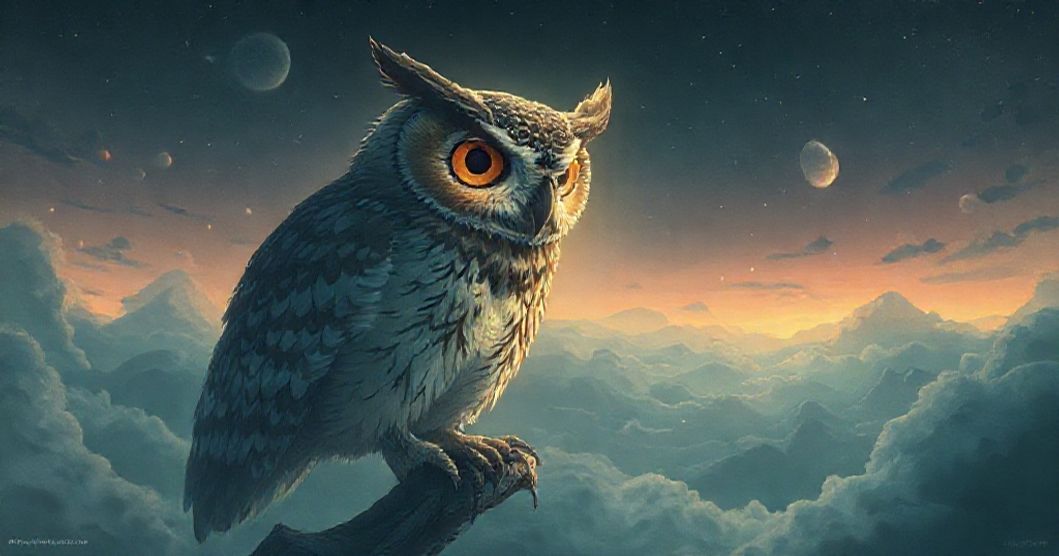
Dreams often present us with uncanny creatures that serve as messengers from our unconscious mind. In this particular nocturnal vision, a striking figure emerged—a cyclops owl with a single human eye at its center, its avian form distorted by this distinctly human feature. The dream unfolded in a surreal landscape where strange growths protruded from the ground, adding to the dream’s unsettling atmosphere. The creature approached with jerky, predatory hops, its single eye locking onto the dreamer’s gaze with an intensity that felt both wise and threatening. The dreamer’s instinctual response—kicking the creature to drive it away—culminated in a physical awakening as the foot struck the wall, leaving the dreamer to grapple with the lingering impression of this uncanny encounter.
I woke with a jolt, still processing the strange dream that had just concluded. It began in a dimly lit space where the ground beneath me seemed to pulse with life—twisted tendrils and small, spiky growths pushing upward from the earth, their purpose unclear. Then, emerging from this surreal landscape, a creature unlike anything I’d ever seen: an owl, but with a single, enormous human eye where its face should be. The eye itself was striking—pale, with a faint glimmer that suggested both intelligence and intensity—and surrounding it were two distinct black-and-white circular markings, like halos or ancient sigils, framing its singular vision. Its body, though, was unmistakably avian: sleek black feathers with crisp white accents, wings folded tightly against its sides, yet it moved not with the silent grace of an owl but with a jerky, almost predatory hop toward me. As it approached, I felt an immediate sense of unease—a primal warning that this was no ordinary animal. Its single eye seemed to lock onto mine, unblinking, as if assessing my thoughts, my weaknesses. I tried to back away, but my feet felt rooted to the ground. Then, in a moment of instinct, I raised my leg and kicked. The first kick landed against what I thought was the creature’s side, but it barely budged, its form shifting slightly as if made of shadow. I kicked again, harder, the movement fueled by a growing sense of panic. The third kick—my final attempt—connected with something solid beside me, and I woke with a start, heart pounding, to the sound of my own foot striking the wall of my bedroom. The cyclops owl had vanished, leaving only the residue of its uncanny presence and the vague memory of those strange, poking growths in the dream’s background. I couldn’t recall the color of the eye, but its impact lingered.
Part 2: Clinical Analysis
Want a More Personalized Interpretation?
Get your own AI-powered dream analysis tailored specifically to your dream
🔮Try Dream Analysis FreeSymbolic Landscape: Decoding the Cyclops Owl and Eye
The central figure of this dream—the cyclops owl with a single human eye—represents a powerful fusion of symbolic elements that demand careful unpacking. In traditional dream symbolism, owls universally signify wisdom, intuition, and the ability to see beyond the veil of the conscious mind. Their nocturnal nature aligns with the unconscious, where they often appear as guides to hidden truths. However, this owl is not just any owl; it is a cyclops, bearing a single human eye. This singular eye disrupts the natural duality of the owl’s vision, creating a paradox: the wisdom and intuition of the owl (a creature associated with the unconscious) combined with the clarity and self-awareness of human perception (the waking mind).
The single eye itself carries profound meaning. In dream imagery, eyes typically symbolize the “window to the soul,” representing how we perceive ourselves and the world. A single eye suggests a narrowed focus—either hyper-intense concentration or a loss of perspective. The human eye within an avian form creates a striking juxtaposition: the owl’s intuitive “inner eye” (a Jungian concept of the collective unconscious) merged with the human eye’s conscious awareness. This hybridity may indicate a tension between trusting one’s intuition and relying on rational thought—a common internal conflict in waking life.
The black-and-white coloration of the owl and its surroundings reinforces themes of duality and contrast. Black often symbolizes the unknown, mystery, or the shadow self, while white represents purity, clarity, or the light of consciousness. The circular markings around the eye could function as symbolic boundaries or thresholds, suggesting that the dreamer is navigating a liminal space between two states of being—perhaps between intuition and logic, or between the known and the unknown.
The act of kicking the owl is equally significant. In dreams, physical aggression typically reflects an attempt to expel or resist something unwanted from the psyche. The dreamer’s repeated kicks and eventual awakening by striking the wall suggest a primal defense mechanism against a perceived threat to the self. This threat may not be literal but rather symbolic of an idea, relationship, or situation that feels invasive or overwhelming.
Psychological Undercurrents: Jungian and Freudian Perspectives
From a Jungian perspective, the cyclops owl embodies the archetype of the “wise old one” (a trickster figure in some traditions) but with a distorted, single-minded focus. Jung viewed dreams as attempts to balance the conscious and unconscious minds, and this dream may be addressing a need for integration between rational thinking and intuitive wisdom. The single eye could represent the “monocle of the self”—an overemphasis on one aspect of perception at the expense of others.
Freudian theory might interpret the owl as a manifestation of repressed desires or fears. The aggression in the dream (kicking the owl) could stem from the dreamer’s unconscious defense against something they perceive as threatening to their ego. The owl’s uncanny appearance might symbolize a repressed fear of being judged or misunderstood, with the single eye functioning as a critical “watcher” figure.
Cognitive dream research offers another lens, suggesting that dreams process recent waking experiences. If the dreamer has recently faced a situation requiring difficult decisions or clarity, the single-eyed owl could represent an attempt to make sense of conflicting information. The kicking action might reflect the dreamer’s internal struggle to resolve ambiguity or assert control over a situation.
Emotional Context: Waking Life Triggers
The emotional tone of the dream—unease, panic, and eventual aggression—likely mirrors waking-life stressors. The dreamer’s sense of being “watched” or “judged” (evidenced by the owl’s intense gaze) may reflect real-world anxieties about performance, relationships, or self-presentation. The single eye could symbolize an external pressure to conform to a particular standard of perception—perhaps in work, social interactions, or personal growth.
The surreal environment with “things poking or growing out of the ground” suggests emerging concerns or unresolved issues. In waking life, this might manifest as unaddressed problems that feel like they’re “growing” unnoticed until they demand attention. The dream’s setting could be a metaphor for the dreamer’s internal landscape, where small, overlooked elements are accumulating into larger issues.
The act of kicking the owl may also represent a defense against emotional overwhelm. If the dreamer has been avoiding a difficult conversation or confronting a challenge, the dream externalizes this avoidance into a physical action of resistance.
Therapeutic Insights: Integrating the Dream’s Message
This dream invites the dreamer to explore the tension between their intuitive and rational selves. The single-eyed owl suggests a need to question whether they are over-reliant on one form of knowing—either trusting intuition without critical thought or overanalyzing without trusting their gut.
Reflective practices can help unpack this tension. Journaling about recent decisions where they felt torn between “knowing” and “thinking” could reveal patterns. Mindfulness exercises focusing on the present moment might help balance the “single-minded” focus of the dream’s imagery with a more integrated, whole-brained approach to life.
The aggressive kicking action, while initially seen as a negative response, can be reframed as a healthy assertiveness. The dreamer might benefit from examining areas where they need to assert boundaries in waking life—not by expelling or attacking, but by setting clear limits with people, tasks, or self-defeating thoughts.
Finally, the dream’s emphasis on the “unknown” (the colorless eye, the surreal growths) suggests a call to embrace uncertainty rather than resist it. Practices like meditation or creative visualization could help the dreamer develop tolerance for ambiguity, recognizing that both clarity and mystery have value in their lives.
FAQ Section
Q: What does it mean to have a single-eyed creature in a dream?
A: A single eye often symbolizes singular focus, intuition, or a one-sided perspective. In this case, it may reflect tension between trusting intuition (owl) and conscious awareness (human eye), suggesting a need to balance these two modes of perception.
Q: Why did the dreamer feel aggressive toward the owl?
A: The aggression likely represents an unconscious defense against a perceived threat to self or values. This could mirror real-world situations where the dreamer feels overwhelmed, judged, or pressured to conform, triggering the need to resist.
Q: How does the black-and-white color scheme influence interpretation?
A: Black-and-white duality suggests contrast between the unknown (shadow) and clarity (consciousness). It may indicate a period of decision-making or uncertainty where the dreamer is navigating conflicting forces in their life.
Keywords: cyclops owl, single human eye, dream symbolism, intuition, conscious awareness, black and white, kicking aggression, surreal growths, liminal space, archetypal figure Entities: cyclops owl, human eye, black-and-white markings, kicking action, growing tendrils