
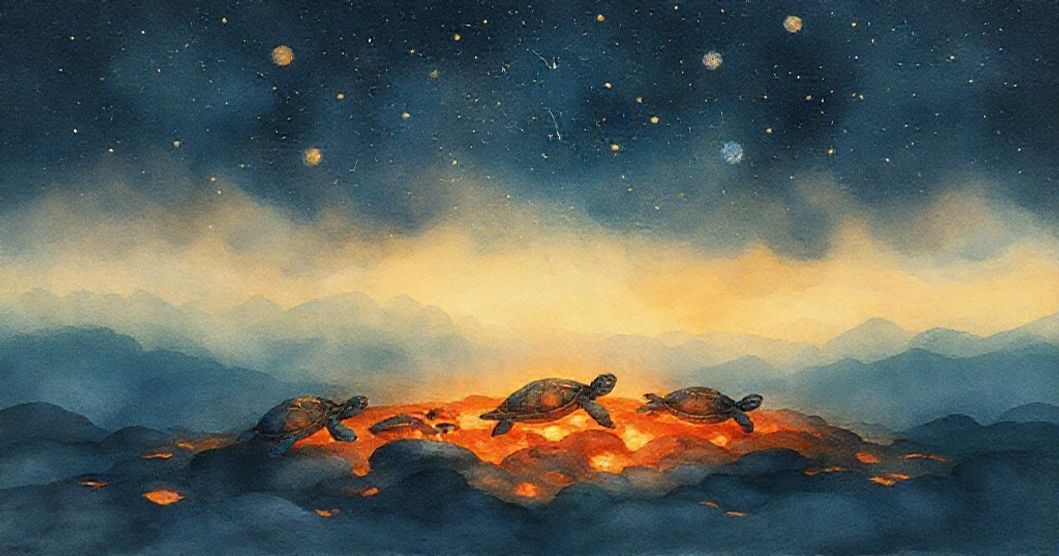
Core Symbols: The Interplay of Turtle, Embers, and Constellations
The turtle in your dream isn’t just a shelled creature—it’s a symbol of emotional anchoring. Turtles move slowly, yet their shells protect deep vulnerability beneath steady exterior. When you cradle one, you’re holding something fragile yet enduring, suggesting you may be grappling with preserving emotional boundaries while nurturing growth. The embers add another layer: these glowing remnants of fire represent unspent energy, passions that haven’t fully ignited or emotions still smoldering from past experiences. Unlike flames, embers hold potential warmth without immediate danger, hinting at repressed feelings waiting to be acknowledged.
Now, the constellations hum as your dream’s final piece. Constellations aren’t random stars—they’re human-made stories connecting points of light. Their hum implies a silent communication, like your subconscious trying to tell you something without words. Together, these elements form a narrative: you’re holding onto emotional anchors (turtles) while tending to residual energy (embers), and your psyche is weaving meaning from scattered experiences into a guiding pattern (constellations). This isn’t just a dream; it’s a metaphor for how you process your inner world—both the steady parts and the smoldering, unacknowledged ones.
Psychology Lens: From Jungian Archetypes to Modern Brain Science
Want a More Personalized Interpretation?
Get your own AI-powered dream analysis tailored specifically to your dream
🔮Try Dream Analysis FreeCarl Jung would likely view this dream through the lens of the ‘wise old man’ or ‘anima/animus’ archetypes, where turtles represent the wise, grounded self and constellations embody the collective unconscious’s narrative power. But modern neuroscience adds another dimension: during REM sleep, your brain processes emotional memories, turning them into symbolic stories. The ‘hum’ of constellations might reflect your brain’s attempt to consolidate emotional data into coherent patterns—your mind literally trying to make sense of fragmented feelings.
Consider this: when we dream, our prefrontal cortex (the logical part of the brain) is quiet, allowing the limbic system (emotional center) to take over. The turtles here could be your amygdala’s way of reminding you to slow down and protect your emotional core, while the embers mirror the hippocampus’s role in reprocessing old memories. The constellations? They’re like your brain’s attempt to assign meaning to random emotional data, creating order from chaos—a survival mechanism.
Culturally, turtles hold deep significance across traditions. In Chinese mythology, the tortoise carries the world on its back, symbolizing stability and longevity. In Aztec lore, the turtle was a creator deity, representing renewal. The constellations, too, vary by culture: the Big Dipper guides travelers, Orion tells stories of hunters, and the Southern Cross anchors identity for many. Your dream’s constellations might reflect whichever cultural or personal ‘compass’ your subconscious is currently consulting.
Life Triggers: When This Dream Appears in Your Life
This dream often surfaces during pivotal life moments where you’re balancing stability and change. If you’re in a career transition, the turtle could represent your need to ‘carry’ your values forward, while the embers might be the passion you’re leaving behind. For example, someone leaving a corporate job for art might dream of cradling turtles (their steady, reliable self) while holding embers (the smoldering desire to create). The constellations then become their new creative path, humming with potential.
Relationships also spark this dream. If you’re in a partnership where you feel unheard, the constellations’ hum could symbolize your need for recognition. The turtles might be your emotional patience, while the embers are the residual hurt from unspoken needs. A reader once shared: ‘I dreamed of cradling a turtle with embers in my palm while the Big Dipper glowed above. I’d just started therapy, and the dream felt like my therapist’s voice—steady, warm, and guiding me to connect the dots between my past (embers) and future (constellations).’
Digital age living adds another layer: the ‘hum’ of constellations might reflect how we’re simultaneously connected and disconnected. In a world of constant notifications, our brains crave meaning-making symbols—turtles (slowing down), embers (reclaiming focus), and constellations (finding purpose in noise).
What To Do Next: Turning Dream Insight Into Action
Start with short-term reflection: Ask yourself, ‘What emotional anchors am I holding onto?’ Journal about a turtle you’ve encountered in waking life—maybe a slow-moving moment, a protective boundary, or a steady relationship. Notice if the embers feel like something you’ve let die (a hobby, a friendship) or something you’re still nurturing (a passion project).
For medium-term experimentation, create a ‘dream altar’ with items representing each symbol: a small turtle figurine (turtles), a candle (embers), and a star chart (constellations). Light the candle daily, focusing on what the embers remind you to tend to. Then, ask: ‘What constellation of actions would help me move forward?’ This practice helps externalize the internal dialogue.
Long-term integration involves emotional mapping. Use the ‘turtle-ember-constellation’ framework to track recurring themes in your dreams and journal entries. When you notice a pattern, ask: ‘How am I balancing my need for stability (turtles) with my need for growth (embers)?’ and ‘Which constellation (path) am I being called to follow?’
Remember, dreams don’t give answers—they give questions. This one is asking you to tend to both the steady and the smoldering, to recognize your inner wisdom, and to trust the patterns your subconscious is weaving.
FAQ: Answering Common Questions About This Dream
Q: What if the dream feels disturbing, like the turtles are heavy or the embers burn? A: Disturbing elements often highlight unprocessed emotions. The burning embers might mean you’re suppressing anger or grief. Try journaling about what’s ‘burning’ and whether you need to extinguish or nurture it.
Q: Is this a warning or a message about my future? A: Dreams rarely warn; they reflect. The constellations hum as your psyche’s attempt to make sense of current emotions, not predict the future. Use it as a mirror, not a crystal ball.
Q: How do I tell if this is unique to me or a common dream symbol? A: While turtle and constellation symbols are common, the ‘cradling embers’ part is personal. The unique twist here is the combination—your dream is a custom narrative of your specific emotional journey, not a generic symbol.