
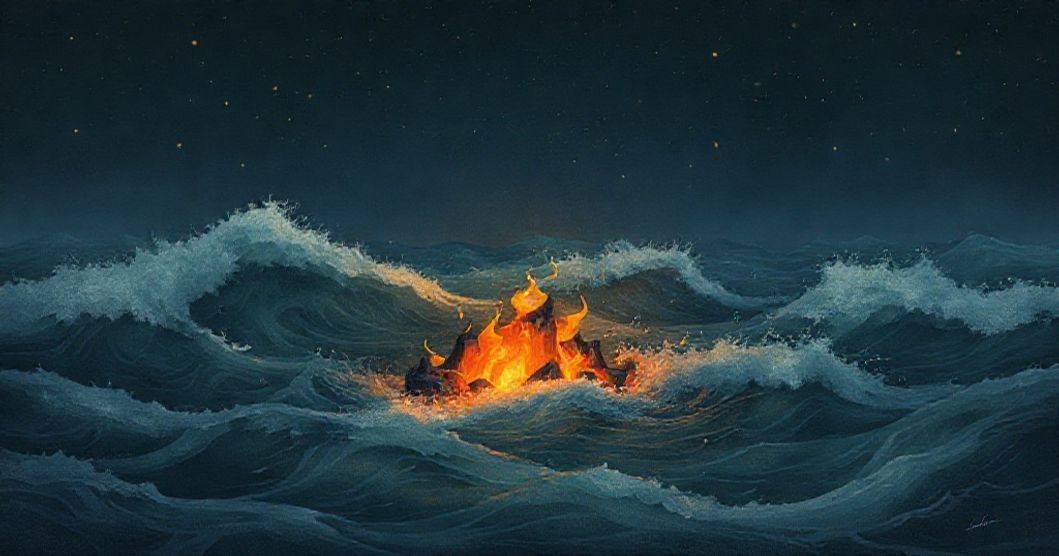
Core Symbols: Embers, Tsunamis, and Constellations in Your Subconscious
The tsunami in dreams typically represents life’s overwhelming forces—whether emotional upheaval, sudden change, or existential uncertainty. But here, the tsunami isn’t just destruction; it’s paired with embers, those tiny, glowing remnants of fire that refuse to die. Embers carry the paradox of destruction and preservation: they’re what’s left after the blaze, yet still capable of warmth and rekindling. Your act of cradling them suggests intentionality—perhaps you’re clinging to something precious amid chaos, even if it feels fragile.
Tsunami constellations add another layer: constellations are human-made patterns in the night sky, born from connecting scattered stars. In dreams, they symbolize the mind’s innate need to impose order on chaos, to find meaning in fragmentation. The 'hum' of constellations hints at a subtle, almost imperceptible rhythm beneath the surface—like the quiet guidance of intuition or the universe’s underlying patterns. Together, these symbols paint a portrait of a mind caught between surrendering to chaos and actively shaping meaning from it.
Psychology Lens: Trauma, Resilience, and the Brain’s Narrative Magic
Want a More Personalized Interpretation?
Get your own AI-powered dream analysis tailored specifically to your dream
🔮Try Dream Analysis FreeFrom a Jungian perspective, tsunamis might represent the 'shadow' archetype—the parts of ourselves we fear or suppress. But the embers and constellations suggest you’re not just confronting the shadow; you’re integrating it. Jung believed dreams act as bridges between conscious and unconscious, and here, the imagery could be your psyche’s attempt to reconcile overwhelming events with your sense of self.
Neuroscience offers another angle: during REM sleep, the brain processes emotional memories, often fragmenting them into symbolic narratives. The tsunami could mirror how the amygdala (emotion center) floods with stress responses, while the embers and constellations reflect the prefrontal cortex’s attempt to organize this chaos into coherent patterns. Think of it as your brain’s way of saying, 'I know this is overwhelming, but I’m still trying to find order in the wreckage.'
Life Triggers: When Chaos Meets Creation in Your Waking World
These dreams often surface during periods of profound transition—job loss, relationship endings, or even internal shifts like redefining your identity. If you’ve recently experienced a 'tsunami' of change, your subconscious might be processing both the terror and the potential for renewal.
The 'cradling' action hints at something personal you’re nurturing: a project, a relationship, or even a belief system. The embers could be this thing—small, but vital. The constellations might emerge if you’ve been seeking structure in chaos, like trying to find purpose in a seemingly meaningless situation.
Consider cultural parallels: In Polynesian mythology, tsunamis are manifestations of gods’ anger, yet also signs of purification. The embers here echo the Hindu concept of 'agnis'—fire that burns away impurities, leaving only what’s essential. Your dream might be your soul’s way of saying, 'I’m not just surviving the storm; I’m learning to carry its lessons.'
What To Do Next: From Dream to Daily Life
Short-Term Reflection: Journal the Embers’ Texture
Ask yourself: What does the 'cradling' feel like? Is it warm, shaky, or steady? The sensation matters. If it’s warm, you might be holding onto something nourishing; if shaky, perhaps you’re still processing vulnerability. Note the constellations’ shapes—do they form a familiar pattern from your waking life? This could be your mind’s way of referencing a solution you’ve already forgotten.
Medium-Term Experimentation: Create Your Own 'Embers Ritual'
Pick a small, tangible way to honor your emotional 'embers.' It could be lighting a candle nightly, keeping a gratitude journal, or even taking a walk to collect small stones (representing stability). This ritual reinforces the idea that even after chaos, you can nurture what’s left.
Long-Term Integration: Map Your Constellations
Look for patterns in your daily life that mirror the constellations. Are you noticing order in unexpected places? If you’re feeling lost, this could be your subconscious guiding you toward a new path. Consider the constellations as your personal 'map'—they’re not just stars, but signposts for what matters.
FAQ: Navigating the Layers of Your Dream
Q: What if the embers feel cold and dead in my dream? A: Cold embers suggest unresolved grief or suppressed emotions. This isn’t failure—it’s your mind’s way of acknowledging what’s still hurting. Try gentle reflection: 'What part of me feels extinguished right now?'
Q: Why do I feel both terror and calm in the dream? A: Dreams often blend emotional extremes. The terror is your amygdala processing stress; the calm comes from your prefrontal cortex recognizing resilience. This duality is healthy—it means you’re both acknowledging pain and trusting your ability to adapt.
Q: Is this a warning or a message of hope? A: It’s both. The tsunami warns of potential overwhelm, but the embers and constellations promise renewal. Your subconscious is saying, 'I know this is hard, but you’re not alone in the storm—and you’re already building something stronger from its ashes.'