
Part 1: Dream Presentation
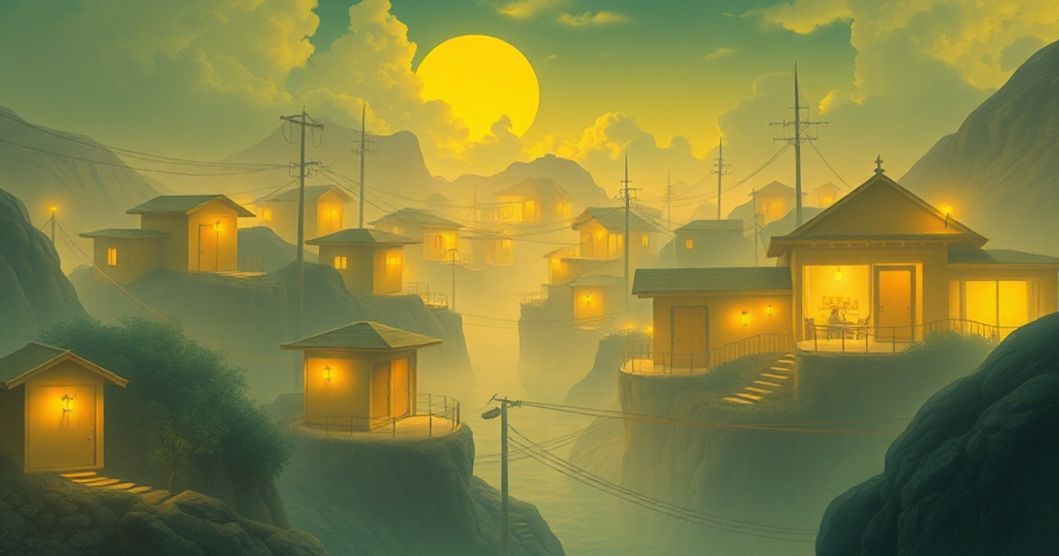
During a night of feverish disorientation from a stubborn cold, my consciousness slipped into a dreamscape where color itself seemed to pulse with emotional texture—a world bathed in yellow that felt both achingly familiar and strangely alien. As I stepped into this realm, I found myself in a village rendered in soft watercolor strokes, its buildings and streets flowing together like a living painting. The air hummed with a warmth I hadn’t felt in days, despite the chills racking my waking body. I lived here for months, though time stretched and warped within the dream’s boundaries, making exact measurement impossible. The people who populated this yellow world were unlike anything I’d ever seen: simple, fluid drawings in varying shades of gold and lemon, their movements like delicate hand-animated figures—each step a gentle, almost imperceptible shift of ink on paper. Yet despite their simplicity, they felt deeply alive, their smiles and greetings radiating a warmth that seeped into my bones. I knew I was friends with all of them, their faces blending into a collective memory of comfort and belonging. Most vividly, I recognized myself as the daughter of Meredith, the complex and morally conflicted character from Dragon Age 2, a figure whose story had haunted me with its themes of redemption and regret. In the dream, this connection felt urgent: I was on a mission to make amends for her choices, to prove that kindness could undo past harm. With this purpose, I gave away all my money and material goods without hesitation, distributing them to the yellow villagers as a gesture of friendship and atonement. Their gratitude was tangible, though I noticed no one questioned where these items came from or why I offered them so freely. My curiosity about the world beyond this yellow haven eventually overcame my contentment. On the horizon, I spotted a stark boundary—a crisp line where the yellow village ended abruptly, and beyond it lay an expanse of pure, empty white. It called to me like a mystery, a question mark waiting to be answered. I tried to cross it, but every time I reached the edge, I was instantly transported back to the village, deposited either on a yellow farm or in a sunlit square, as if the world itself was looping my attempts. I wasn’t desperate to leave, only genuinely curious—this was the first time in my life (or in the dream) that I’d encountered a clear limit to my experience. The loop felt both comforting and confining, a paradox I couldn’t quite parse. Then, slowly, the yellow villagers began to disappear. First one, then another, their forms dissolving like watercolor washes on paper. I watched in quiet horror as the streets emptied, the farms fell silent, and the once-bustling village shrank to just me. The warmth I’d felt earlier curdled into something colder, more hollow. Finally, alone in the vast yellow expanse, I woke with a start, heart racing and mind still clinging to the weight of that empty, white horizon just beyond my reach.
Part 2: Clinical Analysis
Symbolic Landscape: Color, Boundaries, and Disappearance
Want a More Personalized Interpretation?
Get your own AI-powered dream analysis tailored specifically to your dream
🔮Try Dream Analysis FreeThe dream’s vivid yellow village is rich with symbolic resonance, beginning with the color itself—a hue that traditionally signifies both optimism and caution, warmth and warning. In this context, yellow functions as a paradoxical backdrop: it evokes comfort and safety (the familiar watercolor aesthetic, the welcoming villagers) yet contains an underlying tension (the cold, empty white beyond the boundary). The village’s structure as a contained, enclosed space suggests a psychological “comfort zone”—a microcosm of the self where the dreamer seeks connection and purpose. The watercolor medium adds an ephemeral quality, hinting that this sense of belonging might be fragile or illusory.
The defined edge between yellow and white represents a critical boundary in dream symbolism—a threshold between the known and unknown, the conscious and unconscious. In Jungian terms, this edge could signify the shadow self or the boundary between the ego and the collective unconscious. The white emptiness beyond is not just a visual contrast but a psychological one: white often symbolizes purity, potential, or the unknown, while the repetition of reappearing in the village (despite the dreamer’s curiosity) suggests an internal loop—patterns or unresolved issues that keep us returning to familiar emotional territory.
The yellow villagers, drawn like hand-animated figures, represent fluid, ever-changing aspects of the self or relationships. Their disappearance mirrors the dissolution of these aspects, suggesting a loss of connection or identity. The dreamer’s act of giving away money and material goods is a powerful symbolic gesture of self-sacrifice, possibly tied to a desire to prove worth or redeem a past mistake (evidenced by the Meredith reference from Dragon Age 2). This giving without expectation hints at a need for validation or a belief that true connection requires selflessness.
Psychological Perspectives: Illness, Archetypes, and the Unconscious
From a Jungian perspective, the yellow village embodies the “self”—the integrated whole of conscious and unconscious parts. The dreamer’s role as Meredith’s daughter introduces the “shadow” archetype, a figure representing repressed aspects of the self. In Dragon Age 2, Meredith is a complex character whose actions lead to both destruction and potential redemption, making her a perfect symbol for the shadow: a part of the self we wish to fix or reconcile. The dreamer’s mission to “redeem her actions” reflects a desire to heal past wounds or correct perceived failures.
Freud might interpret the dream through the lens of wish fulfillment and the unconscious mind’s need to process unresolved conflicts. The act of giving away goods could represent a regression to childhood, where sharing is a primary way to gain approval. The fever itself, as a physical state of disorientation, might lower emotional defenses, allowing the unconscious to surface with more raw, unfiltered symbols. The looping boundary-crossing could signify an unconscious resistance to change—even as the dreamer seeks exploration, the ego clings to the familiar.
Cognitive dream theory offers another angle: during illness, the brain processes stress and emotional states through fragmented narratives. Fever-induced dreams often reflect the body’s need to integrate discomfort, and the dream’s emphasis on boundaries and loss may mirror the dreamer’s real-life experience of feeling confined or limited (perhaps by illness, relationships, or self-imposed constraints).
Emotional & Life Context: Fever, Regret, and Boundaries
The dream unfolds during a period of physical illness—a time of vulnerability that amplifies emotional sensitivity. Fever dreams often act as emotional “processing” mechanisms, allowing the mind to confront feelings it might suppress during waking hours. The yellow village’s initial warmth contrasts with the later isolation, suggesting a shift from emotional safety to disconnection, possibly tied to recent relationship stress or guilt.
The Dragon Age 2 reference to Meredith adds a layer of personal significance: perhaps the dreamer has been reflecting on a character (or real person) whose choices they wish to correct or redeem. This could indicate a desire to reconcile with someone or to make amends for a past mistake. The act of giving away goods without reciprocation hints at a fear of being rejected if one’s true self is revealed—a common theme in dreams of vulnerability.
The tension between the desire to explore (crossing the boundary) and the compulsion to return (the loop) suggests a core conflict: the need for security versus the need for growth. During illness, this conflict intensifies, as the body craves safety while the mind yearns for meaning. The slow disappearance of others mirrors the dreamer’s real-life experience of relationships fraying or feeling alone despite efforts to connect.
Therapeutic Insights: Self-Reflection and Boundary Awareness
This dream invites the dreamer to explore several therapeutic themes. First, the act of giving away goods without hesitation suggests a need to examine the motivation behind self-sacrifice: Is this generosity coming from a place of self-love or self-negation? Journaling about recent relationships or decisions where giving was prioritized over self-care could reveal patterns of people-pleasing or fear of conflict.
The boundary-crossing loop is a powerful metaphor for emotional patterns. The dreamer might benefit from exploring what keeps them in familiar, even confining situations. This could involve asking: “What do I gain by staying in comfort zones, even when I feel curious about change?” Setting small boundaries in waking life—say, limiting time with people who drain energy—might help break the loop.
The loss of the yellow villagers could symbolize the need to let go of relationships or identities that no longer serve. This process of letting go isn’t about abandoning connection but about recognizing when bonds have run their course or when the self has outgrown certain roles. The dreamer might benefit from practicing mindfulness around these moments of letting go, rather than resisting them.
Finally, the white emptiness beyond the boundary isn’t just a threat—it’s a symbol of potential. The dreamer’s curiosity about this unknown suggests a healthy desire for exploration. In waking life, this could translate into small steps toward new experiences, even if they feel uncomfortable. The fever, as a physical state, reminds us that vulnerability can be a gateway to deeper self-understanding.
FAQ Section
Q: What does the yellow color symbolize in this dream?
A: Yellow often represents emotional warmth and optimism, but here it also carries caution—suggesting a fragile sense of safety or a boundary between comfort and vulnerability. The color’s intensity hints at both the allure and the limitations of this emotional space.
Q: Why do the villagers disappear, and what does this signify?
A: Their disappearance symbolizes the dissolution of connection or identity aspects. It may reflect real-life losses, or the dreamer’s unconscious processing of letting go of people or roles that no longer feel authentic.
Q: How does the fever context influence the dream’s meaning?
A: Fever-induced dreams often intensify emotional states, making unresolved conflicts more visible. The dream’s themes of boundary, sacrifice, and loss may mirror the physical discomfort, amplifying the need to process emotions through symbolic narrative.