
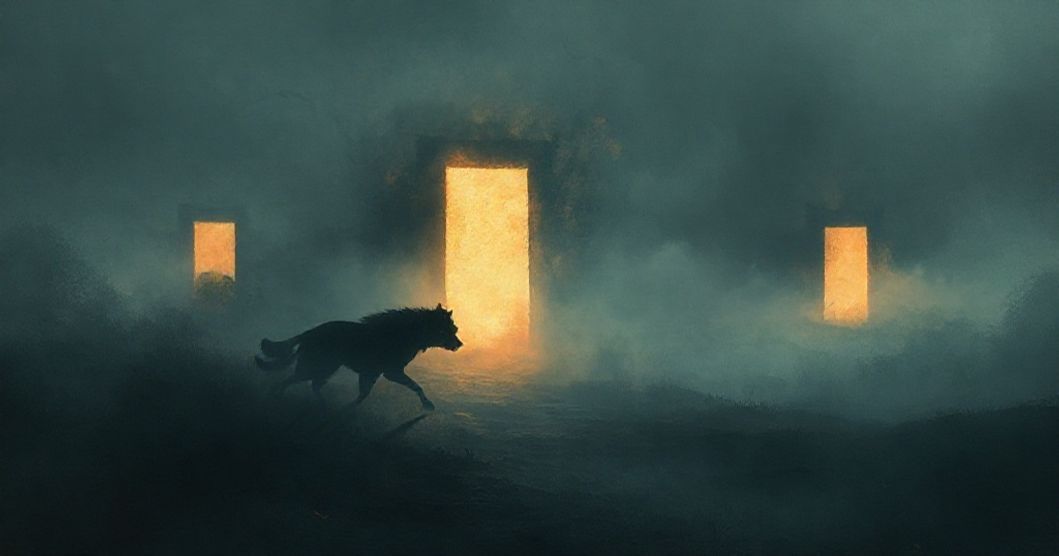
When you find yourself chasing wolves through doorways in dreams, the scene carries an almost tangible tension—the kind of urgency that stays with you long after waking. This isn’t just any dream; it’s a psychological puzzle wrapped in primal imagery, where each element—the wolf’s shadow, the creaking threshold, the echoing call—whispers a specific message about your inner world. Let’s unpack this layered symbolism, exploring why wolves, doorways, and echoes collide in your subconscious, and what they might reveal about your emotional landscape.
Core Symbols: Wolves, Doorways, and Echoes
Wolves in dreams are rarely one-dimensional predators; they’re complex archetypes that shift between primal warning and wise guide, depending on context. In Indigenous traditions, they symbolize community, intuition, and the wild wisdom of untamed self—think of the Lakota belief that wolves teach balance between independence and connection. In Jungian psychology, the wolf often represents the shadow: those untamed, unacknowledged parts of yourself that lurk beneath conscious awareness. When paired with doorways, this shadow takes on a threshold quality—doorways, in dream language, are universal symbols of transition: new beginnings, unspoken endings, or the liminal spaces between life stages. A half-open door might signal uncertainty about a choice; a closed one, resistance to change.
Then there are the echoes—the dream’s most elusive element. Echoes aren’t just repetitions; they’re emotional reverberations, like a song you can’t stop humming but can’t quite place. In dreams, echoes often materialize as unresolved themes: a relationship that ended too soon, a career path abandoned, or a fear you’ve buried. The act of chasing these echoes through doorways suggests your subconscious is trying to close the loop on something left unfinished, yet the wolf’s presence introduces a layer of primal urgency—this isn’t a gentle pursuit but a determined one, as if the wolf itself is both the pursuer and the pursued.
Want a More Personalized Interpretation?
Get your own AI-powered dream analysis tailored specifically to your dream
🔮Try Dream Analysis FreePsychology Lens: From Neuroscience to Jungian Shadows
Neuroscience offers a concrete explanation for this dream’s persistence: during REM sleep (when 90% of vivid dreaming occurs), the brain processes emotional memories through the amygdala and hippocampus, essentially 'replaying' unresolved feelings. The wolf’s intensity might stem from your amygdala flagging a recent emotional trigger—a stressful interaction, a loss, or even a social rejection—while the doorway represents the hippocampus’s attempt to contextualize this memory within your life story. This explains why the dream feels so real: your brain is stitching together emotional data into a narrative that feels urgent, even if the details are fuzzy.
Jungian psychology adds depth by framing the wolf as a shadow archetype—not an enemy but a teacher. In his work, the shadow contains parts of ourselves we’ve disowned, and encountering it in dreams is a call to integration. The doorways here become portals to these shadowed parts: each doorway you pass through is a step toward acknowledging something you’ve avoided. The 'echoes' then become the shadow’s way of saying, ‘I’m still here, and I need to be seen.’ Compare this to Freud’s view, which might reduce the wolf to repressed sexual energy—a valid interpretation, but limited. Jung’s lens expands it to include the full spectrum of our humanity, including the primal, instinctual parts we’ve outgrown or feared.
Life Triggers: When the Subconscious Calls
This dream rarely appears randomly; it’s often triggered by specific life transitions. If you’re in a period of change—a new job, moving home, or ending a long-term relationship—the doorway becomes a literal representation of that shift, and the wolf mirrors your instinct to adapt. For example, someone starting a new career might chase a wolf through doorways as their brain processes the anxiety of leaving a familiar path and embracing uncertainty.
Unresolved emotional patterns also fuel these dreams. If you’ve recently avoided a difficult conversation, the wolf might symbolize the courage you need to have that talk, while the doorway represents the threshold of vulnerability. Digital age living amplifies this: our brains are bombarded with 'echoes' of past interactions (text messages, social media posts, even news cycles), and the dream’s repetition mirrors how we’re caught in loops of overthinking or regret. The wolf becomes the 'inner critic' urging you to break free from these cycles, while the doorways are the exits you’ve been too afraid to open.
What To Do Next: From Dream to Action
When this dream visits, it’s not a warning but an invitation to explore. Start with short-term reflection: Keep a dream journal, noting the wolf’s behavior (was it running toward you or away?), the door’s state (open, closed, ajar?), and the emotional tone (fear, exhilaration, confusion). Ask yourself: What recent change or relationship feels like a doorway I haven’t crossed? This reflection helps identify the shadow theme your subconscious is highlighting.
Medium-term experimentation involves confronting one small 'echo' at a time. If the dream’s wolf feels like a fear of failure, try a tiny risk—a new hobby, a public speaking attempt—to practice chasing without control. Notice if the 'doorway' in your dream opens wider when you embrace uncertainty rather than resist it. This isn’t about 'catching' the wolf but learning to walk alongside it, recognizing it as a part of your own instinctual wisdom.
Long-term integration means seeing the chase as a lifelong process, not a destination. The wolf will keep appearing in dreams until you’ve integrated those shadowed parts into your conscious self. Think of it as a spiritual practice: each time you face a 'wolf' in waking life (a fear, a habit, a relationship), you’re strengthening your ability to navigate the thresholds of your life with courage and clarity.
FAQ
Q: What if the wolves in my dream are friendly vs. aggressive? A: Friendly wolves suggest harmony with your instinctual self—you’re aligning with your true nature. Aggressive ones signal fear of confronting challenges, urging you to face rather than avoid the 'wolf' in your life.
**Q: Does