
Mountain Lion Doorways: Decoding the Subconscious Chase of Echoes
Core Symbols: The Lion, the Doorway, and the Echo
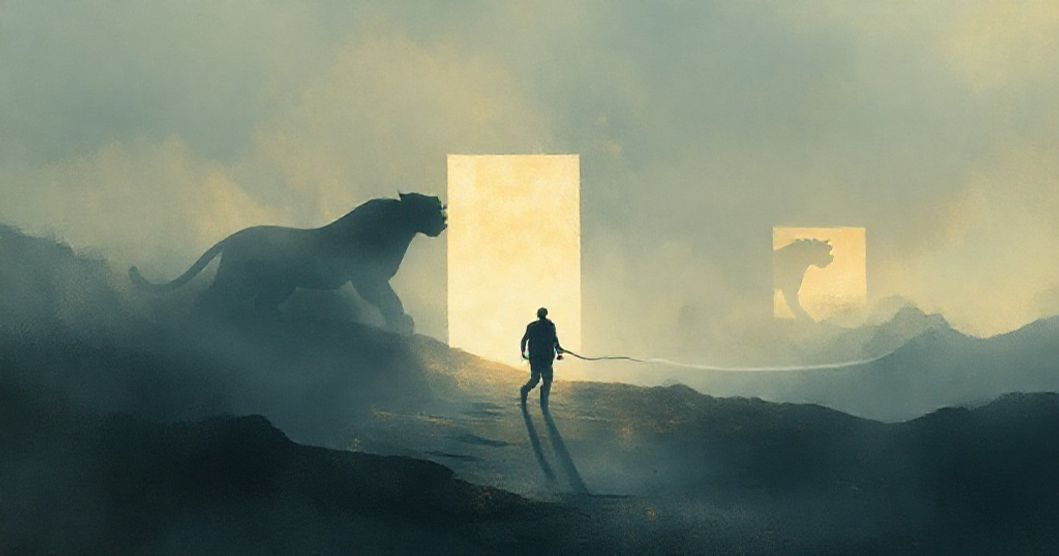
Mountain lions in dreams rarely appear as mere predators—they’re often messengers of primal wisdom. In your vision, the lion isn’t a direct threat but an echo: a shadowy reminder of instincts you’ve numbed or gifts you’ve neglected. This isn’t the roaring, dominant mountain lion of folklore but a spectral presence, its form shifting like memory itself. The lion’s 'echo' quality suggests it’s less about the present and more about the residue of past experiences—the unspoken truths your mind carries like a half-remembered song.
Doorways in dreams are liminal spaces, thresholds between the known and unknown. Unlike literal doorways, these aren’t physical openings but mental boundaries: the line between what you think you want and what you need to do. In your chase, these doorways recede, never fully opening—a classic symbol of avoidance, but also of the subconscious’s way of testing your resolve. The act of 'chasing beyond' implies you’re not just crossing a threshold but pursuing something that’s already slipping away, a pattern of longing that repeats when you resist facing unfinished business.
Psychology Lens: From Jungian Shadows to REM Processing
Want a More Personalized Interpretation?
Get your own AI-powered dream analysis tailored specifically to your dream
🔮Try Dream Analysis FreeJung’s concept of the shadow offers a starting point: the mountain lion embodies your suppressed self—the parts of you that feel too dangerous or powerful to acknowledge. In your dream, the lion isn’t the shadow itself but its echo—the shadow’s voice that refuses to be silenced. Unlike the aggressive shadow in nightmares, this echo is a call, not a condemnation: your unconscious is saying, 'You’ve got something vital here, but you’re not listening.'
Neuroscience adds another layer: during REM sleep, the brain processes emotional memories, turning raw feelings into symbolic narratives. The 'chase' could be your amygdala replaying a pivotal moment—perhaps a time when you hesitated to act on intuition, or a relationship that ended without closure. The mountain lion, then, is the emotional residue of that moment, and the doorways are the neural pathways your mind is trying to rewire. Your brain isn’t just 'dreaming'—it’s healing, using the lion’s echo to remind you of what matters.
Culturally, mountain lions carry dual meanings: in some Indigenous traditions, they’re guardians of thresholds, guiding people through transitions. In Western psychology, they’re often framed as 'predatory'—a clash that mirrors your own internal conflict. The lion as both threat and guide reflects your subconscious’s attempt to reconcile fear with courage.
Life Triggers: When the Subconscious Calls You to Chase
Career crossroads often spark these dreams. If you’re on the verge of a promotion or a new role, the mountain lion might represent the 'primal energy' needed to step into that power. The doorways here are the limits you’ve set for yourself—'I’m not ready' or 'This is too risky.' Your dream is urging you to recognize that the 'echo' of the lion is the courage you already have, just hidden behind self-doubt.
Relationships, too, trigger these echoes. If you’re ending a partnership or redefining a bond, the mountain lion could be the 'unfinished' part of that connection—the love, loyalty, or even anger you haven’t fully processed. The doorways become the 'what ifs' of your heart: 'What if I’d stayed?' or 'What if I’d spoken up?'
Unexpressed creativity is another trigger. The mountain lion, as a symbol of untamed energy, might represent your artistic or entrepreneurial impulse. The doorways are the blank pages, the empty studio, the 'I can’t' voices that block you. Your dream is chasing the echo of that creativity—the version of you that once believed you could do anything.
What To Do Next: From Dream to Daily Life
Start by journaling the emotions of the chase, not just the details. Was it exhilaration or terror? Did the doorways feel open or closed? Notice if you’re chasing something specific in waking life—a goal, a person, or a part of yourself—and ask: 'Is this chase feeding me, or draining me?'
Next, identify your real-life 'doorways.' Are there opportunities you’ve avoided? Relationships you’ve outgrown? Creative projects gathering dust? Pick one small 'doorway' this week and take a step toward it—even if it’s just a conversation or a sketch. The goal isn’t to 'catch' the lion but to let its energy guide your choices.
Long-term, integrate the lion’s wisdom into your daily life. Practice assertiveness without aggression—trust your intuition like a mountain lion trusts its hunt. Notice when you avoid a doorway and ask: 'What’s the echo I’m trying to silence?' By honoring these echoes, you stop chasing shadows and start living with the courage they represent.
FAQ: Navigating the Dream’s Nuances
Q: What if the mountain lion in my dream is not chasing me but I’m chasing it?
A: This reversal shifts the narrative from fear to longing. You’re pursuing something your subconscious sees as vital, not fleeing a threat. It could be a goal, a relationship, or a part of yourself you’ve neglected.
Q: Do doorways in these dreams always mean literal transitions?
A: No—doorways often symbolize internal barriers. If you feel stuck in a job or relationship, the doorway might represent the mental 'I can’t' that blocks you from growth.
Q: Why do I keep having 'echoes' of the lion, not the lion itself?
A: Echoes suggest unresolved past experiences. Your mind is looping to resolve something incomplete—perhaps a regret, a missed chance, or a suppressed truth. The lion’s echo is your subconscious’s way of saying, 'Finish this story.'