
Part 1: Dream Presentation
Dreams often serve as portals to the unconscious mind, revealing hidden aspects of our psyche through symbolic imagery. In this series of remarkably lucid dreams, the dreamer encounters three distinct alien archetypes that collectively reflect a deeper exploration of existential concerns, identity, and relationships. As the narrative unfolds, these cosmic encounters transform into a psychological mirror, reflecting both the dreamer’s yearnings and fears.
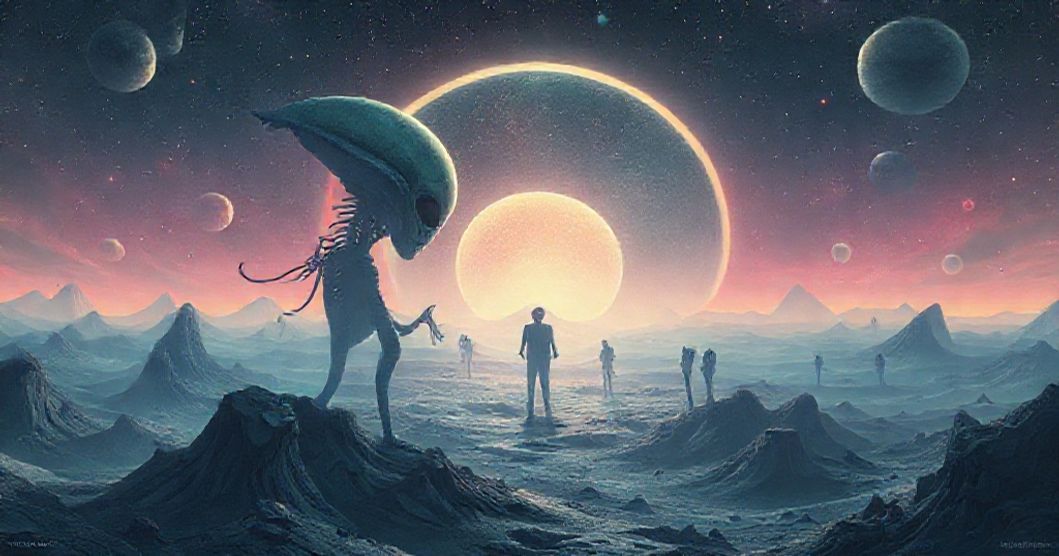
I’ve been haunted by a series of remarkably lucid dreams this month, all centered around encounters with alien civilizations—each painting a different cosmic portrait of humanity’s place in the universe. In the first dream, I found myself standing on a sun-dappled street, surrounded by people of every hue and height, when beings indistinguishable from us in appearance approached. Their eyes held a sense of urgent compassion, not fear or hostility. They spoke directly, not in words but in a language of warmth and clarity: “The Earth is not safe. Choose to come with us, or face destruction.” Their ships were not sleek or angular but organic, like floating gardens with gentle, pulsating lights. Inside, the living spaces curved around me, filled with soft hums and the scent of starflowers. We traveled alongside a massive mother ship, passing other worlds where alien species thrived—some crystalline, others with tentacled forests. On their home planet, I learned they were one of many civilizations; some kind, some predatory, all aware of Earth’s potential. My choice felt not like a decision but a recognition: I belonged to this new family of stars. In another dream, the scene shifted to a cold, metallic training deck aboard a mothership. Humans were corralled into groups of twelve, stripped of their free will, and forced into military drills. The trainers were a hybrid species—most humanoid, except for their leader, a towering figure with a rat’s head and a human torso, its eyes glinting with calculating intelligence. They barked orders in a language I somehow understood, yet felt alien to my core. We were divided by numbers, pitted against each other in mock battles, and conditioned to see ourselves as tools for war. A third dream thrust me into a landscape of shattered cities, where colossal, Predator-like creatures stalked through the ruins. They moved with feline grace, their infrared vision glowing as they hunted. Humans scattered, hiding in alleyways, but no escape was possible. The air reeked of ozone and burning flesh as these beings methodically eliminated anyone in their path, their hunger for resources and territory evident in every movement. In these dreams, I felt both terror and a strange clarity—a dreamer who could see the patterns beneath the chaos. Each alien species mirrored something in myself I hadn’t yet acknowledged, and the choices I made—whether to flee or fight, to trust or fear—revealed truths about my waking life’s uncertainties.
Part 2: Clinical Analysis
Want a More Personalized Interpretation?
Get your own AI-powered dream analysis tailored specifically to your dream
🔮Try Dream Analysis FreeSymbolic Landscape: Aliens as Archetypal Projections
The alien encounters in these dreams function as powerful symbolic representations of the dreamer’s internal landscape. In Jungian psychology, aliens often manifest as projections of the collective unconscious—archetypal figures that reflect both the self and its shadow. The friendly, human-like aliens represent the anima/animus archetype, embodying the dreamer’s desire for integration and wholeness. Their diverse appearance and urgent invitation suggest a longing for connection with fragmented parts of the self or a search for meaning in an uncertain world. The rat-headed leader, by contrast, embodies the shadow archetype—representing repressed aspects of self that feel threatening or unacknowledged. Rats in dream symbolism often signify decay, corruption, or fear of being “trapped” in oppressive systems, while the hybrid form (human body, animal head) reflects the dreamer’s struggle with identity boundaries.
The resource-invading Predator-like species embodies the destructive shadow—an existential threat to core values and safety. These beings’ hunger for resources without regard for life mirrors the dreamer’s fears of being consumed by external forces (work, relationships, societal pressures) that feel predatory. The division into groups and training scenarios highlight the persona archetype—how we present ourselves in social contexts—and the fear of losing agency in structured systems.
Psychological Perspectives: Jungian, Freudian, and Cognitive Frameworks
From a Jungian perspective, these dreams represent the dreamer’s attempt to integrate disparate aspects of self through encounters with the unknown. The three distinct alien species correspond to different aspects of the shadow: the friendly aliens as the Self’s potential for growth, the rat-headed leader as the shadow’s oppressive control, and the Predator as existential anxiety. In Freudian terms, the dreams may reflect repressed fears of loss of control, symbolized by the forced training and invasion scenarios. The “choice” in the first dream could represent the ego’s attempt to resolve conflicting desires for safety versus adventure.
Cognitive psychology frames dreams as problem-solving mechanisms, where the brain processes unresolved issues. The recurring invasion themes might signal the dreamer’s mind working through real-life challenges—perhaps uncertainty about career changes, relationship dynamics, or existential questions about purpose. The lucid quality of the dreams (a rare gift) suggests the dreamer is developing self-awareness, using dreams as a testing ground for new perspectives.
Emotional & Life Context: Unpacking the Subtext
The dreams likely reflect the dreamer’s current emotional state—possibly feeling overwhelmed by external pressures or facing a period of transition. The urgent “choice” in the first dream mirrors real-life decisions where the dreamer feels pressured to align with a path that may or may not be authentic. The rat-headed leader’s dehumanizing training suggests fear of being reduced to a “tool” in a system that values efficiency over humanity—a common anxiety in modern work environments or social structures.
The Predator-like species’ focus on resources and elimination taps into existential fears about scarcity—whether economic, relational, or spiritual. In a world of increasing uncertainty, these dreams may be the psyche’s way of processing collective anxieties about climate change, technological disruption, or social division. The recurring nature of the dreams suggests these themes are unresolved in the waking mind, needing attention.
Therapeutic Insights: Integrating the Cosmic Messages
Dreams serve as internal messengers, and these alien encounters invite the dreamer to explore which “species” they are aligning with in waking life. Journaling exercises could help identify which aspects of the dreams feel most resonant: Do you identify with the friendly aliens’ invitation, or do you fear being “trapped” by the rat-headed leader’s control? Reflective questions like “What do I fear losing if I choose the friendly path?” and “Where do I feel hunted or hunted by external forces?” can clarify internal conflicts.
Creative visualization techniques might help integrate these insights—imagining a safe space where the friendly aliens’ guidance and the shadow’s lessons coexist. Dream incubation (setting an intention before sleep) could be useful for resolving specific anxieties. For the rat-headed leader’s shadow aspect, shadow work practices like self-compassion meditation or journaling to uncover repressed anger or fear could foster integration.
FAQ Section
Q: What does it mean to choose the friendly aliens in my dream?
A: Choosing the friendly aliens symbolizes your ego’s recognition of opportunities for growth and connection. It suggests you’re ready to embrace vulnerability and trust in life’s possibilities, even when uncertainty looms.
Q: Why does the rat-headed leader appear as a hybrid creature?
A: The rat-headed leader embodies the shadow’s dual nature—humanity’s potential for both rationality and irrationality. The animal head represents instinctual fears or unprocessed emotions, while the human torso shows how these shadow elements infiltrate conscious life.
Q: How can I distinguish between helpful and harmful influences in my life?
A: Reflect on the “energy” of each encounter. Does the experience feel expansive and empowering (friendly aliens) or constricting and dehumanizing (rat-headed leader)? Use this energy as a compass for decision-making, aligning with choices that nourish your wholeness.