
Core Symbols: Trains, Tides, and the Rhythm of Choice
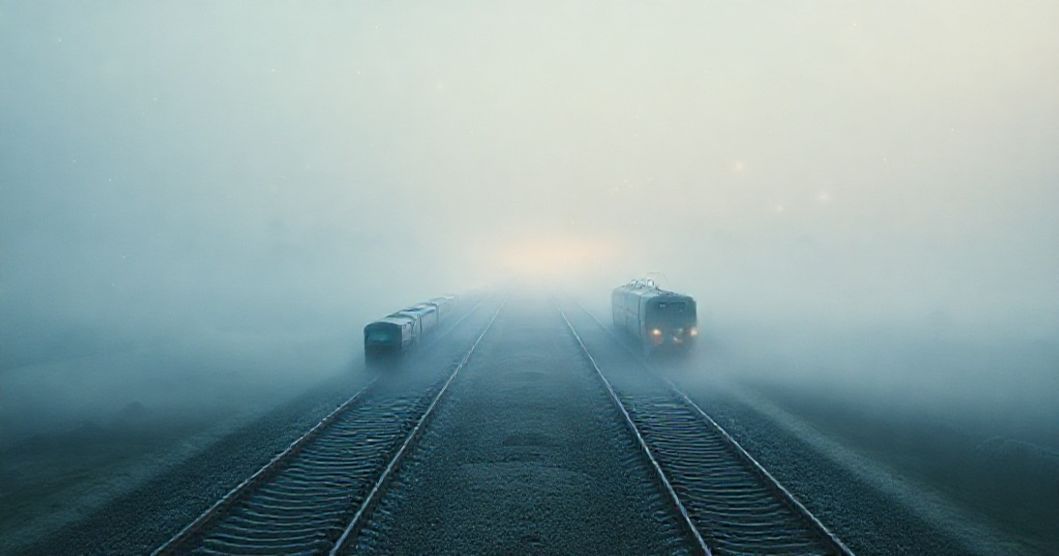
Trains in dreams traditionally symbolize life’s directional currents—progress, societal programming, or the 'path' we’re meant to follow. When multiple trains appear, especially moving in parallel, they represent competing life paths: career ambition vs. emotional needs, personal growth vs. stability, or even the tension between different versions of yourself (e.g., professional self vs. creative self). The 'tides' element adds another layer: like ocean waves, they introduce the idea of natural, inevitable flow, suggesting life isn’t static but cyclical. A train station with overlapping tracks might mirror a crossroads where decisions feel both urgent and fluid, while a train moving alongside another could signify the subconscious’s recognition of simultaneous truths—you don’t have to choose one track over the other.
Consider a dream where two trains glide past each other at a station: this isn’t just a collision of paths, but a meeting of energies. The 'tides' here might represent the rhythm of your internal clock—how your body and mind process change, ebb, and flow. Trains, in this context, are not just vehicles but metaphors for the 'programmed' narratives we carry: the 'shoulds' versus the 'wants' that feel equally valid. The subconscious uses this duality to highlight that life’s most meaningful growth often comes from integrating these parallel forces, not eliminating one.
Psychology Lens: From Jungian Archetypes to Neurobiological Processing
Want a More Personalized Interpretation?
Get your own AI-powered dream analysis tailored specifically to your dream
🔮Try Dream Analysis FreeCarl Jung’s concept of the 'shadow' offers insight: when we dream of parallel trains, we’re confronting aspects of ourselves we’ve split off—parts of our identity we’ve deemed 'incompatible' or 'too much.' The 'tides' could reflect the shadow’s cyclical nature, as unresolved parts of the self return in dreams to demand attention. For example, a person torn between a stable job and a creative passion might dream of two trains, one labeled 'Security' and the other 'Fulfillment,' with tides symbolizing the shadow’s persistent pull to reconcile these opposites.
Neuroscience adds another dimension: during REM sleep, the brain’s default mode network activates, processing emotional memories and unresolved conflicts. Trains in dreams often represent the 'replay' of conflicting neural pathways—your brain’s attempt to resolve ambivalence by creating a symbolic scenario. The 'tides' might mirror the amygdala’s role in emotional regulation, as the mind tries to balance the intensity of competing feelings (excitement vs. fear, hope vs. doubt). Unlike Freud’s view of dreams as wish-fulfillment, modern psychology sees these dreams as problem-solving tools, with the subconscious acting as a therapist, using symbolic trains to help you 'see' your choices more clearly.
Life Triggers: When the Subconscious Calls for Alignment
In contemporary life, 'trains beside trains' often emerge during periods of decision overload: the side hustle vs. full-time job, digital presence vs. physical connection, or societal expectations vs. personal values. The 'tides' can symbolize the collective anxiety of keeping up with others’ timelines—social media’s 'fast train' of productivity versus the slower, more intentional 'local train' of personal growth. You might dream of this when feeling pulled in two directions: your LinkedIn profile says 'ambitious' while your heart says 'fulfilled,' creating a subconscious dissonance.
Modern life amplifies this tension: remote work blurs the line between 'work train' and 'home train,' while digital communication feels like 'parallel tracks' of connection without depth. The 'tides' here might represent the overwhelm of constant information—your mind trying to process too many 'next steps' at once. If you’re experiencing burnout, this dream could signal the need to slow down and notice which 'train' you’re actually on, or if you’ve been on autopilot, following a schedule that isn’t yours.
What To Do Next: From Dream to Action
Start by reflecting on the dream’s details: Which train felt more 'alive'? Was there a station, platform, or specific moment of tension? This mirrors your gut reaction to real-life choices—your body knows what it needs, even if your mind hasn’t caught up. Ask yourself: 'Which path feels like it’s moving toward my core values, not away from them?' Journaling these observations can help you map the 'tides' of your own decision-making.
Medium-term, experiment with small steps in one direction. If the dream feels like a choice between stability and spontaneity, try a 30-day 'spontaneity challenge' (e.g., taking a different route home, signing up for a short course) to see how it aligns with your energy. Notice if the 'tides' of indecision ease as you take concrete action—the subconscious thrives on clarity.
Long-term, look for the intersection where the two trains meet. Often, the answer isn’t to choose one over the other but to find synergy: a career that honors creativity and stability, or a relationship that balances independence and connection. The 'tides' remind us that life isn’t a binary; it’s a spectrum, and your job is to ride the wave rather than fight against it.
FAQ
Q: What does it mean if I dream of trains moving in opposite directions? A: Opposite directions reflect conflicting values or responsibilities—career ambition vs. emotional needs, for example. The subconscious uses this duality to highlight that you don’t have to 'pick a side' but can reconcile these tensions.
Q: Why do I dream of a train station with multiple platforms? A: A busy station symbolizes life’s crossroads, with each platform representing an opportunity or role. The 'tides' suggest these options are in flux, urging you to clarify your priorities rather than get lost in possibilities.
Q: How does the 'tide' element affect the interpretation? A: Tides introduce the idea of natural flow—your life isn’t static. The dream may guide you to surrender to change rather than resist it, trusting that the subconscious knows when to 'let go' and when to 'push forward.'