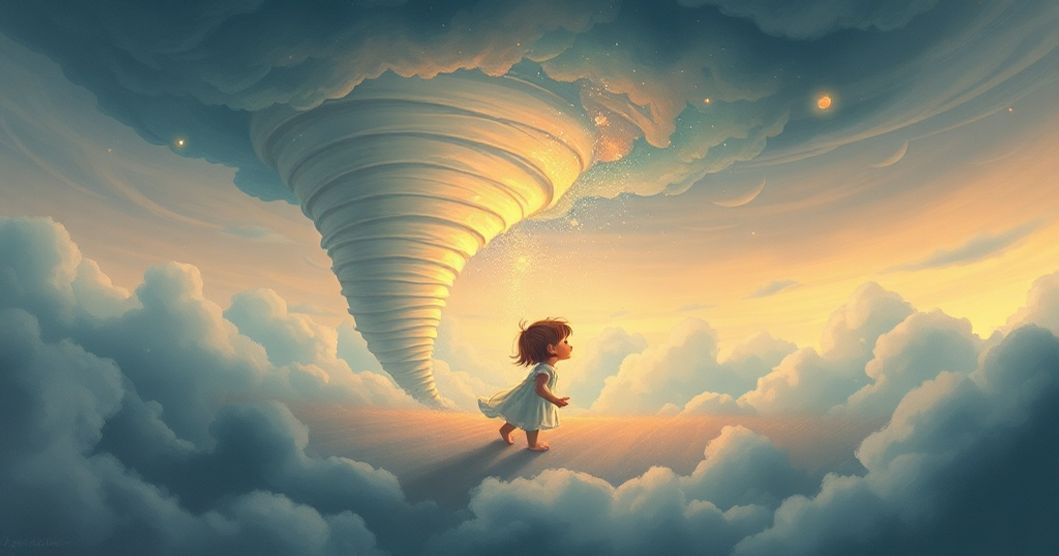
Part 1: Dream Presentation\n\nDreams often serve as portals to the unconscious, where our deepest yearnings and fears manifest in surreal, symbolic forms. This particular dream unfolds as a gentle encounter with a paradoxical creature: a baby tornado that defies physical laws yet embodies a sense of purpose and care. The dreamer wakes to the sensation of something cool and light brushing their face, discovering a swirling, almost invisible presence entering through an open window. Initially unrecognizable, the creature extends upward toward the clouds, its visible form a mere grey tendril that dissipates after a meter—a visual metaphor for something both present and beyond full comprehension.\n\nThe dreamer adopts the tornado as a pet without hesitation, finding comfort in its self-sufficient nature. The creature performs mundane tasks (dusting, drying laundry) with surprising efficiency, revealing an underlying fear of abandonment—a vulnerability that contrasts with its otherwise capable demeanor. On a grassy hill, the dreamer is recognized as 'the Tornado Guy,' and the creature dances atop a coffee thermos, creating a delicate steam column. The dreamer’s playful singing of 'Let’s Call the Whole Thing Off' introduces a layer of whimsical surrender, acknowledging the absurdity of their situation while solidifying their bond. Finally, the dreamer reflects on their connection with this 'baby air elemental,' lamenting the lack of a name to anchor their newfound friendship.\n\n## Part 2: Clinical Analysis\n\n### Symbolic Landscape: The Tornado as Paradoxical Companion\nThe baby tornado in this dream is a powerful symbol of paradox: it embodies both chaos and order, invisibility and tangibility, destruction and care. In Jungian psychology, tornadoes often represent overwhelming forces of change, but here the creature is 'baby'—a diminutive, manageable version of chaos, suggesting the dreamer’s attempt to domesticate or understand unruly aspects of their psyche. The tornado’s grey, dissipating form after a meter hints at the elusive nature of unconscious processes; it is partially visible, partially hidden, much like repressed emotions or untapped potentials.\n\nThe tornado’s helpfulness—dusting, drying clothes—transforms its destructive reputation into one of utility and care. This redefinition suggests the dreamer’s ability to reframe chaos as purposeful action, finding value in unexpected places. The creature’s fear of abandonment mirrors the dreamer’s own vulnerability to feeling overlooked or unneeded, a common theme in dreams about relationships.\n\n### Psychological Currents: Air Element and Emotional Resonance\nFrom a Freudian perspective, the tornado could represent repressed energy seeking expression, while Jungian analysis frames it as an archetypal air elemental—a being of communication, movement, and freedom. Air corresponds to the intellect, ideas, and mental processes, so this elemental might symbolize the dreamer’s need for mental agility or creative expression. The 'baby' aspect suggests a desire to reclaim childlike wonder, to approach life with less seriousness and more playfulness.\n\nThe grassy hill, where the dreamer is 'the Tornado Guy,' functions as a threshold between dream and reality, a space where identity shifts from ordinary to extraordinary. The nickname 'Tornado Guy' implies recognition and belonging—a sense of purpose derived from embracing one’s unique qualities, even if they seem unconventional.\n\n### Emotional & Life Context: Fear of Abandonment and Whimsical Connection\nThe dream’s emotional core centers on care and fear of loss. The tornado’s worry about being abandoned likely reflects the dreamer’s waking concerns about relationships, work, or personal identity—fears that even helpful, self-sufficient parts of ourselves might be discarded if we don’t nurture them. The dreamer’s resolve ('Pet for life') signals commitment to self-compassion and long-term care, both for the creature and for their own emotional needs.\n\nThe song 'Let’s Call the Whole Thing Off' introduces a layer of conflict resolution. Cole Porter’s lyrics, originally about romantic differences, here take on new meaning: the dreamer is embracing the absurdity of their situation while reaffirming connection. This suggests the dreamer values harmony over conflict, even with parts of themselves that feel 'different' or unruly.\n\n### Therapeutic Insights: Nurturing the Unseen Self\nThis dream invites the dreamer to recognize the value of embracing the 'invisible' aspects of life—those intangible connections, ideas, or emotions that shape identity. Naming the tornado, as the dreamer regrets not doing, represents the act of giving form to the ineffable, a therapeutic practice of conscious awareness.\n\nPractical reflection exercises could include: 1) Journaling about recent interactions where you felt 'unseen' or 'unappreciated,' and noticing if patterns emerge. 2) Creating a 'whimsical' ritual each day to honor playful, unexpected aspects of your life. 3) Exploring 'chaos' in your routine—perhaps rearranging a space or trying a new activity to foster creativity.\n\n### FAQ Section\nQ: What does a baby tornado symbolize in dreams?\nA: A baby tornado often represents untapped potential, playful energy, or the need to embrace chaos as purposeful. It may signal a desire to reconnect with childlike wonder or reframe overwhelming forces as manageable.\n\nQ: Why was the tornado worried about being abandoned?\nA: This fear likely reflects the dreamer’s waking concerns about relationships, self-worth, or fear of losing purpose. The tornado’s worry mirrors the universal human need for connection and validation.\n\nQ: What is the significance of the song 'Let’s Call the Whole Thing Off'?\nA: The song introduces a playful acknowledgment of differences while reaffirming unity. It suggests the dreamer values harmony over conflict, finding strength in embracing contrasts rather than avoiding them.