
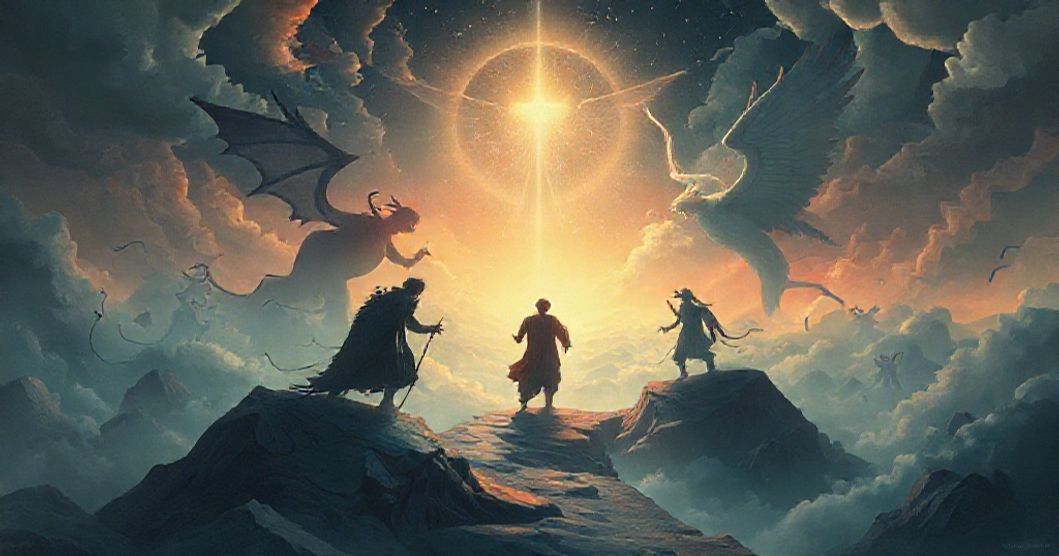
Part 1: Dream Presentation
Dreams have long served as windows into the unconscious mind, revealing truths we cannot always articulate while awake. This particular dream journey begins with a landscape of recurring nightmares and spiritual confusion, transitioning into increasingly luminous and symbolic visions. The dreamer describes a lifelong struggle with supernatural imagery: demonic figures that manifest as shadowy, unblinking women and paralyzing fear, contrasted with angelic presences that offer protection and guidance. Central to these dreams is a forest path with two divergent routes, Jesus’ command to “trust God,” and a recent encounter with Archangel Gabriel in a bathroom, marked by a searing white light and a cryptic symbol.
The narrative unfolds through distinct emotional states: the terror of demonic dreams that paradoxically lifted with prayer, the confusion of forced faith versus personal doubt, and the unsettling dread of being hunted in the Gabriel dream, ultimately resolved by a transformative light. These elements collectively suggest a profound internal dialogue about identity, belief, and the search for meaning in the face of conflicting spiritual influences.
Part 2: Clinical Analysis
Want a More Personalized Interpretation?
Get your own AI-powered dream analysis tailored specifically to your dream
🔮Try Dream Analysis FreeSymbolic Landscape: Demonic and Angelic Imagery
The demonic figures in the dream represent repressed fears and unresolved anxieties rooted in the dreamer’s early experiences with supernatural imagery. The woman with “holeless eyes” and black veins embodies the fear of being watched or judged, a common archetype in dreams of surveillance and vulnerability. Her appearance in old residences may symbolize lingering childhood trauma or family-imposed religious guilt, as the dreamer notes, “It was drilled into me, being with a Christian family.” The “prayer” that ended these nightmares reflects a defense mechanism: the unconscious mind’s attempt to resolve conflict through wish fulfillment, a concept Freud might have linked to the dreamer’s need for safety amid uncertainty.
Conversely, the angelic figures—Jesus, the “small white light,” and Archangel Gabriel—emerge as symbols of protection and guidance. In Jungian terms, these represent the dreamer’s emerging self-awareness and potential for integration. The forest path with two paths is a classic mandala symbol, representing life choices and the tension between safety and exploration. Jesus’ instruction to “trust God” and avoid the other path reflects the dreamer’s internal struggle between obedience and curiosity, while the old man in the electric wheelchair urging the “right” path suggests societal or familial expectations pressing for conformity.
The numerical sequences (9%, 999, 111, 555) function as synchronicities—meaningful coincidences that the dreamer interprets as divine messages. In dream psychology, numbers often symbolize cycles, completion, or spiritual awakening. 999, for example, can represent transformation or spiritual ascension, while 111 signifies intuition and new beginnings. The dreamer’s observation that these numbers appeared in media, clocks, and songs hints at a collective unconscious activation, where the mind synthesizes external stimuli with internal needs.
Psychological Undercurrents: Faith, Doubt, and the Unconscious
Freudian analysis might view these dreams as wish fulfillment: the demonic dreams fulfill a fear of the unknown, while the angelic dreams fulfill a need for safety and meaning. However, Jung’s perspective offers a richer framework, emphasizing the dreams as a process of individuation—the dreamer’s journey toward self-integration. The recurring “light” imagery (white light, copper-brown light) represents the animus/animus archetype, a masculine/feminine balance in the unconscious that mediates between the conscious and unconscious self.
The Gabriel dream introduces a specific religious archetype: Archangel Gabriel, traditionally a messenger of God. In Islamic and Christian traditions, Gabriel delivers divine messages and judgment. In this dream, his role as protector aligns with the dreamer’s need for reassurance during periods of spiritual uncertainty. The “bathroom” setting, a private, vulnerable space, amplifies this symbolism, suggesting the dreamer is processing intimate fears in a safe, contained environment.
The dreamer’s confusion about “why me” and “why now” reflects the tension between external expectations (family-imposed faith) and internal autonomy (personal doubt). This conflict manifests as the recurring “two paths” motif, where the dreamer seeks clarity on whether to follow tradition or forge a new path.
Emotional Context: Conflict and the Search for Meaning
The dreamer’s emotional journey is marked by conflict: the relief of prayers ending demonic nightmares, the confusion of forced faith, and the anxiety of unearthing repressed doubts. The shift from demonic to angelic dreams in early 2024 suggests a psychological turning point—a move from fear-based responses to active engagement with spiritual imagery. This transition parallels the dreamer’s growing self-awareness: from reacting to external religious dictates to questioning and integrating these influences.
The “hunted” feeling in the Gabriel dream mirrors the dreamer’s waking anxiety about being “watched” by societal or familial expectations. The bathroom scene, a space of vulnerability, becomes a site of transformation: the woman’s “symbol” and the light represent the dreamer’s attempt to heal or protect themselves. The “ringing ears” and “ground rumbling” during Gabriel’s arrival suggest a physical manifestation of internal upheaval, as the dreamer’s unconscious processes trauma and growth.
Therapeutic Insights: Integrating Spiritual Dreams into Self-Understanding
For the dreamer, these dreams offer a roadmap for self-exploration rather than literal truth. Journaling exercises that connect numerical symbols to personal experiences can help decode their meaning. For example, reflecting on when 999 appeared might reveal a period of significant change, while 111 could correspond to a new insight.
Exploring the “two paths” metaphor through journaling or guided meditation can clarify life choices. The dreamer might ask: What does “trusting God” mean to me, beyond family tradition? What does the “other path” represent in my waking life? This reflection can transform the dream’s symbolic conflict into actionable self-knowledge.
The recurring “light” imagery suggests the dreamer’s need for illumination—both literal (spiritual) and metaphorical (self-understanding). Engaging with this light through creative visualization or meditation can foster a sense of safety and direction, reducing the dread associated with the “hunted” feeling.
FAQ Section
Q: What does it mean when demonic dreams suddenly stop?
A: The cessation of demonic dreams often signals psychological progress. It may represent the dreamer’s integration of fear or the successful adoption of new coping mechanisms, such as prayer or self-compassion.
Q: How should I interpret the numbers appearing in my life?
A: Numbers in dreams are personal; reflect on when they appear and what you felt. For example, 999 might signal completion, while 111 could indicate a need for trust in intuition.
Q: Does encountering Archangel Gabriel in a dream mean I should embrace Christianity?
A: Dreams of religious figures don’t require dogma. Gabriel’s role as a messenger suggests the dreamer is being called to listen to their inner voice, not necessarily follow external traditions. The “bathroom” setting emphasizes privacy and personal revelation over institutional faith.