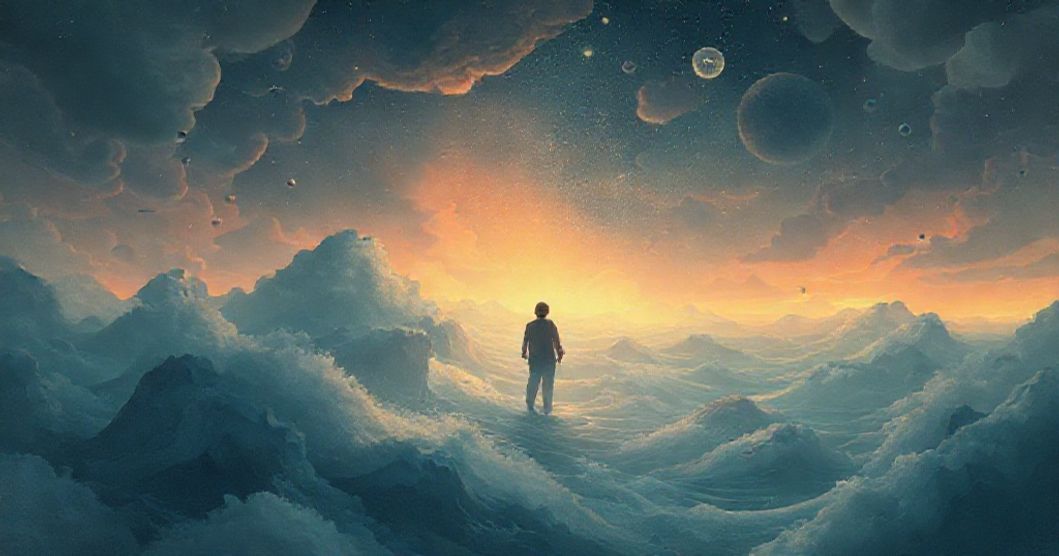
Part 1: Dream Presentation\n\nDreams often serve as psychological mirrors, reflecting our inner landscapes through surreal imagery and symbolic narratives. This particular dream unfolds as a layered journey through liminal spaces, where the dreamer navigates between waking and dreaming states with increasing clarity and emotional resonance. The dream begins in a hybrid waiting area—a gas station-restaurant intersection that symbolizes transitional space, where routine and unexpected events collide. The appearance of the dog, though seemingly benign, triggers protective instincts and tension among family members, setting the stage for themes of safety and boundary.\n\nThe narrative progresses to a parking lot where the dreamer walks alone, disconnected from family, suggesting a subconscious exploration of identity and belonging. The online friend’s unexpected appearance introduces a bridge between virtual and physical relationships, highlighting modern connectivity’s blurred boundaries. The dreamer’s teleportation to a warehouse concert-festival marks a shift into more abstract territory, where reality dissolves and the mind takes creative control.\n\nThe pivotal moment arrives when the dreamer recognizes the dream state upon hearing 'dream,' triggering a cascade of self-awareness. The security guard’s reassurance ('Everything’s under control') contrasts with the dreamer’s assertion of lucidity, creating tension between external validation and internal knowing. The bloated-faced figure embodies the uncanny valley of dream logic—the distortion of familiar forms into something unsettling, reflecting the dreamer’s fear of losing control or identity. Finally, the whiteboard with its cryptic 'cat' sticker offers a fleeting moment of clarity that dissolves upon waking, leaving only fragments of symbolic truth.\n\n## Part 2: Clinical Analysis\n\n### Symbolic Landscape: The Dreamer’s Inner World Unpacked\n\nThe gas station-restaurant waiting room represents the threshold between ordinary reality and the unconscious, where the dreamer encounters family members in a liminal space. This setting mirrors the dreamer’s current life transition, where stability and uncertainty coexist. The dog, appearing without warning, symbolizes repressed fears or anxieties that surface unexpectedly—perhaps unresolved tensions with family or self-doubt about protective roles. Its benign yet alarming presence suggests these emotions are not overtly threatening but demand attention.\n\nThe parking lot sequence embodies the dreamer’s experience of identity fragmentation. Walking alone while family moves forward represents the subconscious awareness of disconnection from one’s own life path, a common theme in dreams of separation. The online friend driving by symbolizes the dreamer’s attempt to reconcile virtual and physical relationships—a modern archetype of digital connectivity that blurs into the dream state, reflecting how technology shapes identity even in sleep.\n\nThe warehouse concert-festival functions as a collective unconscious space, where the crowd represents the dreamer’s social connections and the stage signifies performance or self-expression. The security guard’s role as gatekeeper to the VIP area highlights the dreamer’s desire for access to deeper understanding or 'exclusive' aspects of self, while the stands with games and conversation represent the dreamer’s need for engagement and validation in both social and inner realms.\n\nThe bloated-faced figure is a classic example of the 'uncanny' in dreams, where familiar forms distort into the unfamiliar. This imagery likely reflects the dreamer’s fear of losing control or identity when self-awareness arises—a common Jungian shadow element. The melting face symbolizes the fluidity of identity in dreams, where the ego’s boundaries dissolve when the mind recognizes it’s dreaming.\n\nFinally, the whiteboard with its 'cat' sticker offers a crucial symbolic clue. In dream analysis, cats often represent intuition, independence, and hidden aspects of the self. The sticker’s fleeting clarity before waking suggests the dreamer’s unconscious is attempting to communicate something about intuitive knowing that remains just out of reach—perhaps a message about trusting one’s instincts in waking life.\n\n### Psychological Currents: Theoretical Frameworks Illuminating the Dream\n\nFrom a Jungian perspective, this dream reveals the dreamer’s emerging self-awareness (anima/animus archetype) and the shadow integration process. The bloated face represents the shadow’s distortion when the ego confronts its own darkness. Jung believed dreams act as 'compensations' for conscious imbalances, and here the dreamer’s recognition of the dream state (lucid dreaming) suggests a growing conscious awareness seeking integration.\n\nFreudian analysis might interpret the dream as a manifestation of repressed desires and anxieties. The family tension around the dog could symbolize unresolved familial conflicts, while the online friend represents repressed social needs or unfulfilled connections. The security guard’s reassurance ('Everything’s under control') may reflect the dreamer’s ego’s attempt to maintain order in the face of unconscious turmoil.\n\nCognitive dream theory posits that lucid dreams involve prefrontal cortex activation, explaining the dreamer’s ability to recognize and question reality. The 'dream within a dream' structure (realizing you’re dreaming, then a secondary dream state) suggests meta-cognitive processing—the mind’s ability to reflect on its own dreaming process. This aligns with modern neuroscience research showing that lucid dreaming correlates with enhanced self-monitoring during sleep.\n\n### Emotional and Life Context: Connecting the Dream to Waking Reality\n\nThe dream likely emerges from a period of identity exploration, where the dreamer is navigating changes in relationships, social connections, or self-perception. The family members in the parking lot, though present, remain strangers to the dreamer’s inner experience, suggesting a sense of disconnection from loved ones or difficulty maintaining authentic relationships. The online friend, appearing in a car, represents the dreamer’s reliance on digital connections to feel seen—a common theme in modern life, where virtual interactions sometimes overshadow in-person relationships.\n\nThe tension around the dog may reflect the dreamer’s anxiety about unexpected responsibilities or threats to safety, while the warehouse concert’s ambiguous performance space suggests unexpressed creativity or desire for self-expression. The security guard’s calm reassurance contrasts with the dreamer’s instinct to take action, mirroring the waking tendency to overthink or second-guess decisions.\n\nThe dream’s resolution—the fleeting 'cat' sticker—implies the dreamer is processing intuitive insights about hidden aspects of self. The 'cat' symbol, with its associations with independence and intuition, suggests the dreamer may need to trust their inner wisdom more fully, even when clarity feels elusive.\n\n### Therapeutic Insights: Practical Reflections for the Dreamer\n\nThis dream invites several reflective practices. First, journaling exercises focusing on the 'cat' symbol can help uncover its personal meaning—perhaps exploring areas where intuition has guided the dreamer but been dismissed in waking life. The bloated face, while unsettling, offers an opportunity to confront fears of losing control or identity; mindfulness meditation on accepting uncertainty could mitigate this anxiety.\n\nFor relationship issues, the dreamer might benefit from exploring the 'disconnection' theme in waking life. Asking: 'When do I feel most like an observer in my own relationships?' can reveal patterns of emotional withdrawal or overthinking. The security guard’s role suggests a need to balance assertiveness with trust—learning when to assert boundaries and when to allow others to guide.\n\nThe lucid dream recognition ('this is a dream') offers a metaphor for waking life: practicing 'lucid living'—moment-to-moment awareness of one’s thoughts and actions. Keeping a 'dream journal' for both nighttime dreams and daytime 'waking dreams' (moments of self-awareness) can strengthen this practice.\n\n### FAQ Section\n\nQ: Why did the dog trigger such strong reactions in the dream?\nA: The dog likely symbolizes repressed anxieties or unaddressed family tensions. Its sudden appearance reflects how these issues surface unexpectedly, demanding attention rather than dismissal.\n\nQ: What does the 'bloated face' represent psychologically?\nA: This imagery reflects the uncanny valley of identity—fear of losing self when boundaries dissolve. It may signal the dreamer’s struggle with maintaining control during vulnerable moments.\n\nQ: How should I interpret the 'cat' sticker on the whiteboard?\nA: Cats symbolize intuition and hidden aspects of self. The 'cat' likely represents an unexpressed intuition or overlooked aspect of your personality needing recognition.\n