
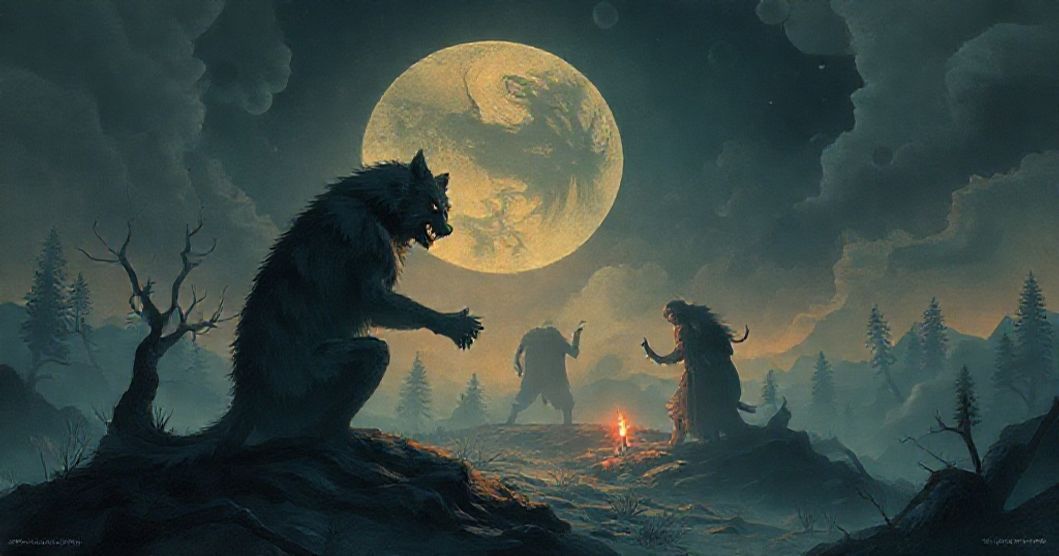
Part 1: Dream Presentation
Dreams often manifest our deepest anxieties and hidden desires through symbolic imagery that defies waking logic. This particular nocturnal narrative, with its primal imagery and ambiguous motivations, offers a window into the dreamer’s psychological landscape. Here is the dream as the dreamer experienced it:
On a dark, fog-choked night, I found myself outside my house, the familiar surroundings warped by an unnatural stillness. The air felt thick with moisture and something primal, as if the world itself held its breath. Standing beside me was a classmate, though his features blurred slightly in the dim light—a disorienting mix of familiarity and strangeness. Without warning, we both began to transform, our bodies shifting into wolf-like forms, yet somehow maintaining an upright posture, halfway between human and beast. The transformation felt both involuntary and inevitable, a shedding of social constraints to reveal something raw and untamed beneath. Our attention was drawn to a small, trembling shape in the distance—a sheep, its wool matted and eyes wide with terror. We instinctively gave chase, the fog swirling around our paws as we ran, the urgency of the hunt overriding all reason. But the sheep was swift, vanishing into the mist before we could close the distance. Disappointment and frustration coursed through me as we stopped, panting. Then my classmate spoke, his voice carrying an odd mixture of encouragement and gravity: 'You would be able to do it. I know you've got what it takes.' I felt a knot of uncertainty in my stomach, unsure of what he meant or what task he was urging me to undertake. Suddenly, we noticed a house with a single glowing window piercing the darkness, a sheep darting toward its safety. Following the animal, we crossed the threshold, the door creaking open behind us. Inside, the warmth of the house clashed with the cold fog outside, and the sheep vanished into the shadows. In their place stood a man, his face taut with fear, though I couldn't place him. Without hesitation, I lunged forward, my bare hands clamping around his neck. The jugular vein pulsed beneath my fingers, warm and vital, and I felt the sudden urge to sever it. The act was brutal, messy—blood sprayed, his struggles weakening as I maintained my grip. He fought briefly, but his resistance crumbled, and his body went limp beneath me. I felt a wave of disgust wash over me, yet also a strange sense of completion. My classmate stood nearby, nodding approvingly, and I swear I heard him murmuring instructions, though the words were indistinct. I knew, somehow, that this man had a family, that his death would leave a void, yet I couldn't stop the momentum. As his body went still, his face paling and eyes losing all life, I realized this must be some form of rite of passage—a transformation I was expected to undergo, though the purpose remained unclear. I followed through not out of conviction, but because my classmate's encouragement carried weight, and I valued his opinion deeply, not wanting to disappoint him. When I woke, the dream's conflicting emotions lingered: horror at the violence, yet a strange sweetness in the completion of the task. I'm left profoundly confused about its meaning.
Part 2: Clinical Analysis
Want a More Personalized Interpretation?
Get your own AI-powered dream analysis tailored specifically to your dream
🔮Try Dream Analysis FreeThe Primal Symbolism: Werewolves, Sheep, and the Killing of the 'Other'
The werewolf imagery in this dream serves as a powerful Jungian archetype representing the dual nature of human existence—the integration of both civilized and primal aspects. The upright werewolf form suggests a tension between social identity and untamed instincts, as the dreamer navigates between human social roles and deeper, instinctual drives. The sheep, with its vulnerability and innocence, functions as a classic symbol of purity and potential sacrifice, while the act of chasing and ultimately killing it represents the pursuit of control over one's environment or inner chaos.
The jugular vein, severed with bare hands, carries significant symbolic weight. In many mythologies, the neck represents the intersection of life force and vulnerability, making this act both an assertion of power and a confrontation with mortality. The 'brutal, messy' nature of the killing contrasts with the dreamer's 'disgust' and subsequent 'strange sweetness,' suggesting the unconscious recognizes this act as necessary for transformation, even if the conscious mind recoils at its implications.
Psychological Layers: Jungian and Freudian Perspectives
From a Jungian framework, this dream embodies the 'hero's journey' threshold moment—the dreamer must confront the shadow self (represented by the werewolf) to achieve psychological integration. The classmate, as a guide figure, reflects the dreamer's need for external validation during this transformative period. The classmate's encouragement ('You would be able to do it') may symbolize the superego urging the dreamer to embrace their potential, even when the task seems terrifying.
Freudian theory, meanwhile, might interpret the violent act as a manifestation of repressed aggression or the death instinct (Thanatos). The 'sweetness' the dreamer feels could represent the unconscious finding relief in the completion of a necessary emotional task, despite the ego's revulsion. The house with the light symbolizes the boundary between conscious awareness (outside the house) and the unconscious (inside), where primal urges emerge.
Emotional Context: Unpacking the 'Sweet' Violence
The dream likely reflects the dreamer's current life context: perhaps a period of identity exploration, social pressure, or fear of disappointing others. The classmate's influence suggests the dreamer is navigating relationships where external approval carries significant weight, possibly in academic or social settings. The 'sweet' feeling despite killing hints at the unconscious finding value in the act of transformation, even if the conscious mind cannot articulate its purpose.
The 'rite of passage' interpretation suggests the dreamer is undergoing a psychological transition, perhaps moving from adolescence to adulthood, or from one social role to another. The ambiguity of 'why' the killing must occur mirrors the dreamer's own uncertainty about their direction in waking life—seeking validation while questioning the morality of their actions.
Therapeutic Insights: Navigating the Unconscious Call to Transformation
This dream invites the dreamer to explore the tension between social expectations and personal authenticity. Journaling exercises could help unpack the classmate's significance—are there influential figures in waking life urging conformity? Reflective questions like 'What aspects of myself feel primal or untamed?' can surface repressed emotions. The 'sweet' element suggests the unconscious finds value in this process, even if the conscious mind fears its implications.
Practical steps include mindfulness practices to observe primal urges without acting impulsively, and distinguishing between external validation and internal conviction. The dream may signal the need to embrace the 'shadow' aspects of self rather than suppressing them, as integration rather than suppression leads to psychological wholeness.
FAQ Section
Q: What does the werewolf transformation symbolize?
A: It represents the integration of primal instincts and social identity, suggesting the need to reconcile civilized behavior with untamed desires for authenticity.
Q: Why did the dreamer feel 'sweet' after killing?
A: The 'sweetness' likely reflects the unconscious recognizing completion of a necessary transformation, even if the conscious mind struggles with the act's morality.
Q: How does the classmate’s encouragement affect interpretation?
A: The classmate symbolizes external validation needs, suggesting the dreamer seeks approval during a period of identity exploration, possibly fearing disappointment from influential figures.