
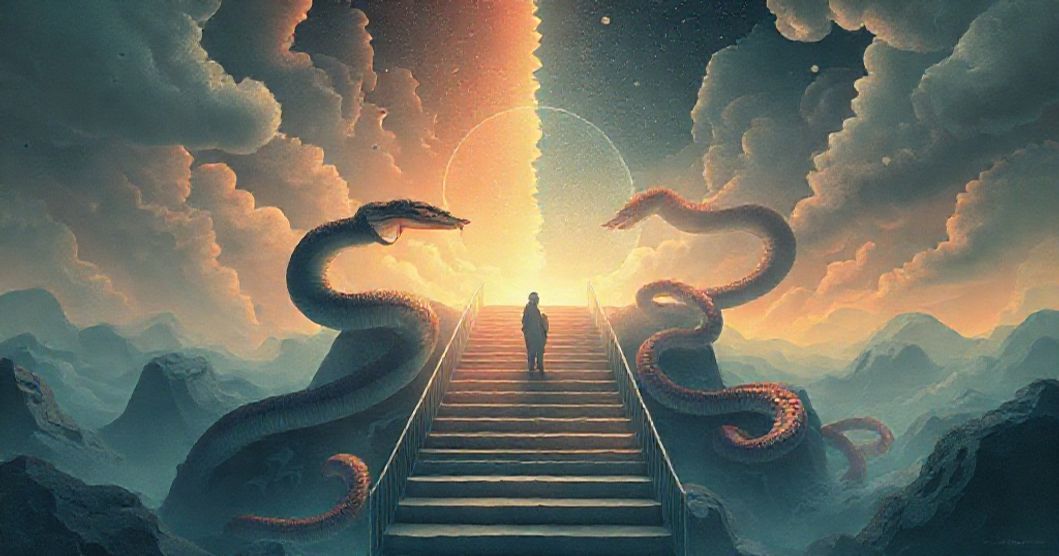
Part 1: Dream Presentation
Dreams often materialize as vivid metaphors for our inner lives, and this particular dream offers a rich tapestry of symbolic imagery that demands careful examination. In a world without oceans, divided between a verdant jungle realm and an arid desert expanse, the dreamer stands at a threshold where these opposing landscapes meet—a threshold marked by a giant white staircase ascending toward a mountain peak in the jungle. Below, on the desert side, a group of ragged figures gazes upward, while one individual defies unspoken rules to climb the stairs, evading three would-be blockers. At the summit, two colossal snakes emerge: one with a human face smiling serenely on its forehead, and another massive serpent of indeterminate form, with the first snake serving the second, raining only on the jungle when it meets the gaze of the smiling face.
The dream’s narrative unfolds as follows: In a world stripped of water, the earth is split into two symbolic realms—the lush, life-giving jungle and the barren, empty desert. This division suggests fundamental dualities in the dreamer’s psyche or external circumstances: perhaps work vs. rest, creativity vs. discipline, or hope vs. despair. The giant white staircase at the boundary between these realms acts as a threshold, a bridge between opposing states. The ragged figures at the base represent those bound by limitations or societal constraints, while the individual who climbs embodies the urge to transcend these boundaries despite warnings.
Part 2: Clinical Analysis
Want a More Personalized Interpretation?
Get your own AI-powered dream analysis tailored specifically to your dream
🔮Try Dream Analysis FreeSymbolic Landscape
The dichotomy of jungle and desert represents fundamental life choices and psychological states. Jungian psychology would interpret this as the shadow and light aspects of the self—the fertile, nurturing jungle (representing growth, emotional depth, and connection) and the arid desert (symbolizing emotional barrenness, isolation, or spiritual drought). The absence of oceans suggests a world where water—an essential element for life—has been severed from its natural context, reflecting a dreamer who may feel emotionally or psychologically parched in one area while thriving in another. The staircase, ascending toward the mountain in the jungle, embodies the journey of self-development, the climb representing the effort to reach higher consciousness or integrate conflicting aspects of the self.
The snakes themselves carry profound symbolic weight. In many mythologies, snakes represent transformation, wisdom, and the unconscious mind. The larger snake with a human face on its forehead merges the reptilian (primordial, instinctual) with the human (conscious, rational), suggesting a reconciliation of these realms. The smiling face introduces an element of unexpected comfort or perhaps deceptive benevolence, hinting at how we might idealize or project positivity onto even our most primal aspects. The second snake, massive yet featureless, represents the unknown or overwhelming aspects of the unconscious that we may feel compelled to serve or submit to.
Psychological Perspectives
From a Freudian lens, the dream might reflect repressed desires or conflicts. The desert could symbolize unfulfilled sexual or aggressive urges, while the jungle represents fertile, socially acceptable outlets for these energies. The forbidden climb mirrors the dreamer’s struggle to express repressed aspects of self, with the three blockers embodying the superego’s attempts to enforce societal norms. The snakes, as phallic symbols, might represent sexual tension or the power dynamics inherent in relationships.
Carl Jung’s analytical psychology offers a complementary perspective, emphasizing the collective unconscious and archetypal patterns. The dual snakes could represent the animus and anima—masculine and feminine aspects of the psyche—with the larger snake serving the smaller, suggesting a need for integration rather than dominance. The smiling face on the snake’s forehead might symbolize the trickster archetype, a figure who both guides and challenges us, offering wisdom through seemingly contradictory means. The rain restricted to the jungle aligns with Jung’s concept of synchronicity, where symbolic events mirror deeper psychological patterns.
Neuroscientifically, the dream’s structure—with its clear narrative arc and symbolic elements—reflects the brain’s attempt to process and integrate disparate experiences during REM sleep. The staircase, as a liminal space, activates the brain’s default mode network, associated with self-referential thought and future planning, while the snakes engage the amygdala, processing emotional significance and threat assessment.
Emotional & Life Context
The dream’s emotional tone suggests tension between safety and adventure, comfort and challenge. The desert’s barrenness may reflect feelings of emotional depletion or a lack of resources in waking life, while the jungle’s abundance hints at potential growth or nourishment. The group of ragged figures at the base of the staircase could represent social isolation or a sense of being out of place, while the individual who climbs alone embodies courage or rebellion against constraints.
The servile dynamic between the snakes—where the larger serves the smaller with the rain restricted to the jungle—might indicate a relationship pattern where the dreamer feels compelled to serve another, perhaps in a professional or personal context, while the rain symbolizes emotional sustenance only available in specific, conditional ways. The inability to block the climber suggests that despite obstacles, the dreamer’s inner drive to ascend is powerful enough to overcome resistance, reflecting resilience in the face of external barriers.
Therapeutic Insights
This dream invites the dreamer to reflect on how they navigate life’s dichotomies—between what is nurturant and what is barren, what is forbidden and what is desired. The act of climbing the staircase despite warnings suggests a willingness to embrace growth even when it violates established norms, a quality to cultivate in waking life.
Practical reflection exercises might include journaling about personal